


Make and receive business calls from any device—desktop, mobile, or browser—without relying on physical phones. Supports hybrid and remote work environments seamlessly.

Modern Business Technology Consulting
Future‑Ready IT, Phone,
and Cloud Systems For
Growing Businesses
Enterprise Teams
Technology Leaders
Tech20 Solutions Inc. designs intelligent, secure, and scalable technology stacks—business phone (VoIP), dedicated internet, cloud, and cybersecurity —so your team can move faster with zero guesswork.
Business Voice
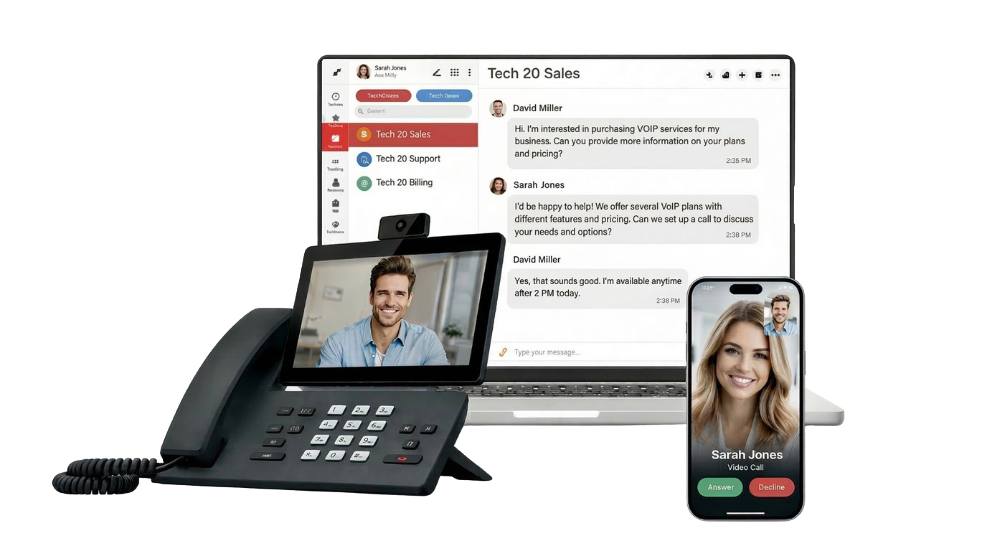
Your business phone system plays a critical role in both internal communication and customer experience. The right solution helps teams stay connected, respond quickly, and collaborate more effectively, while also creating a professional and reliable experience for customers. Although many phone systems may appear similar on the surface, the features, flexibility, scalability, and support behind them can vary significantly.
By identifying your communication priorities early, such as remote work support, call routing, voicemail features, mobile integration, conferencing, analytics, or CRM compatibility, you can more easily narrow down the best solution for your business needs and budget. A clear understanding of your operational requirements helps ensure your phone system supports your workflow today while remaining flexible enough to grow alongside your business.
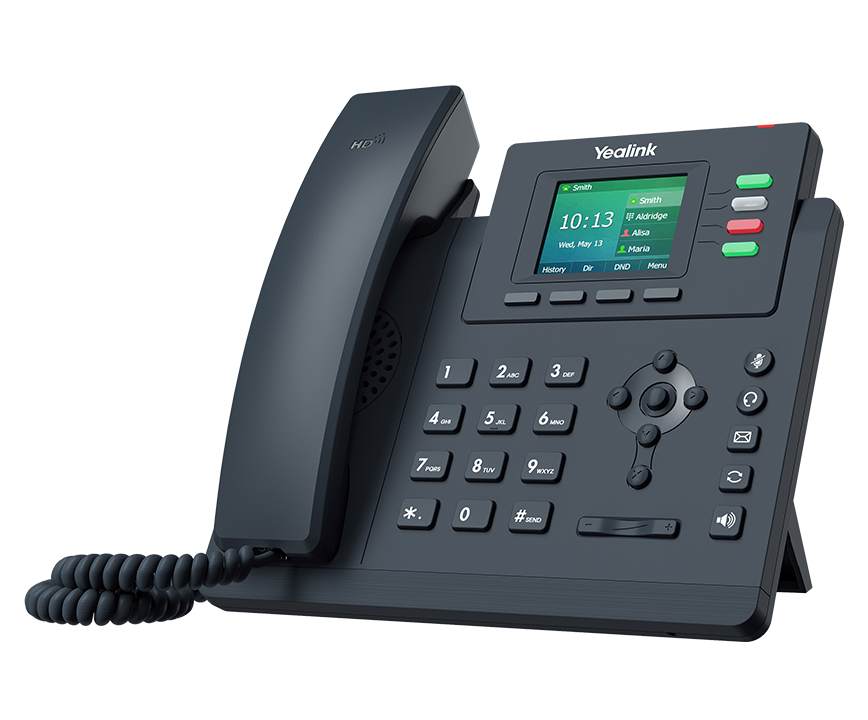
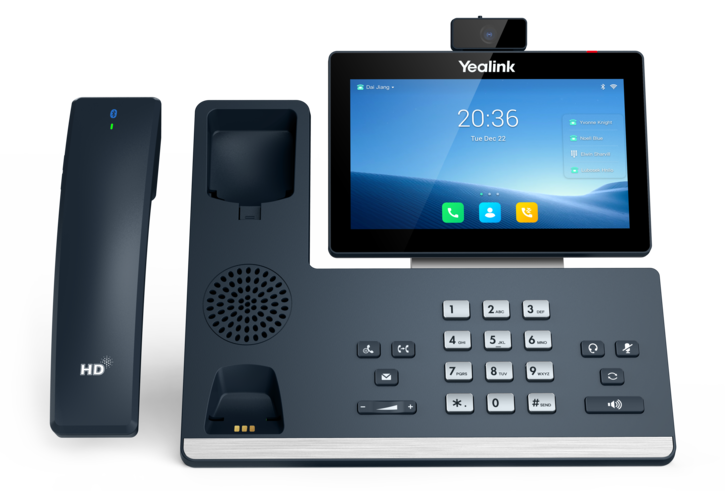
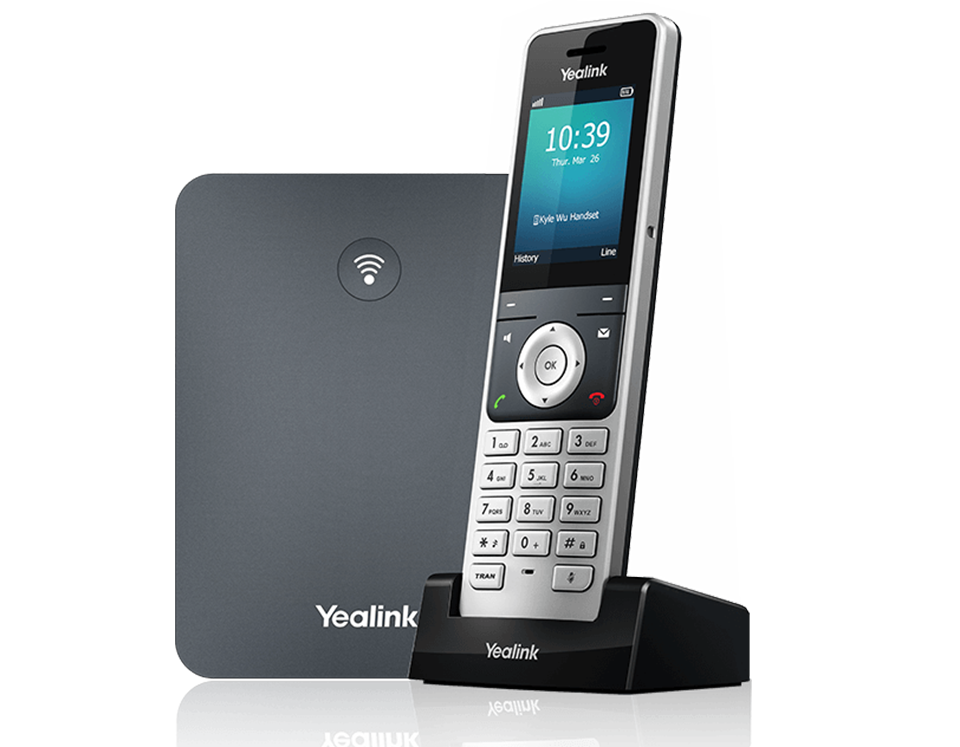
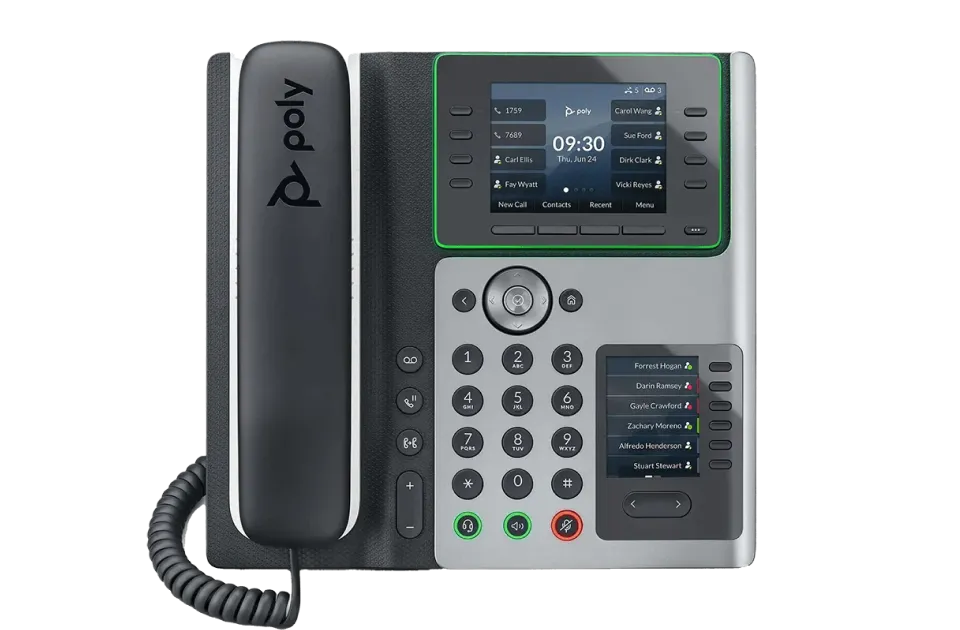
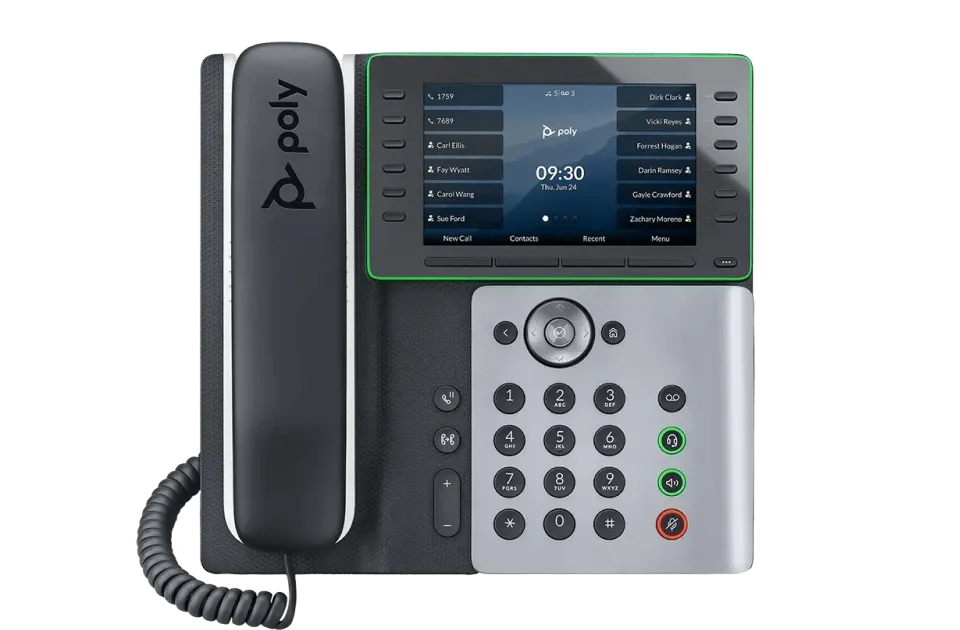
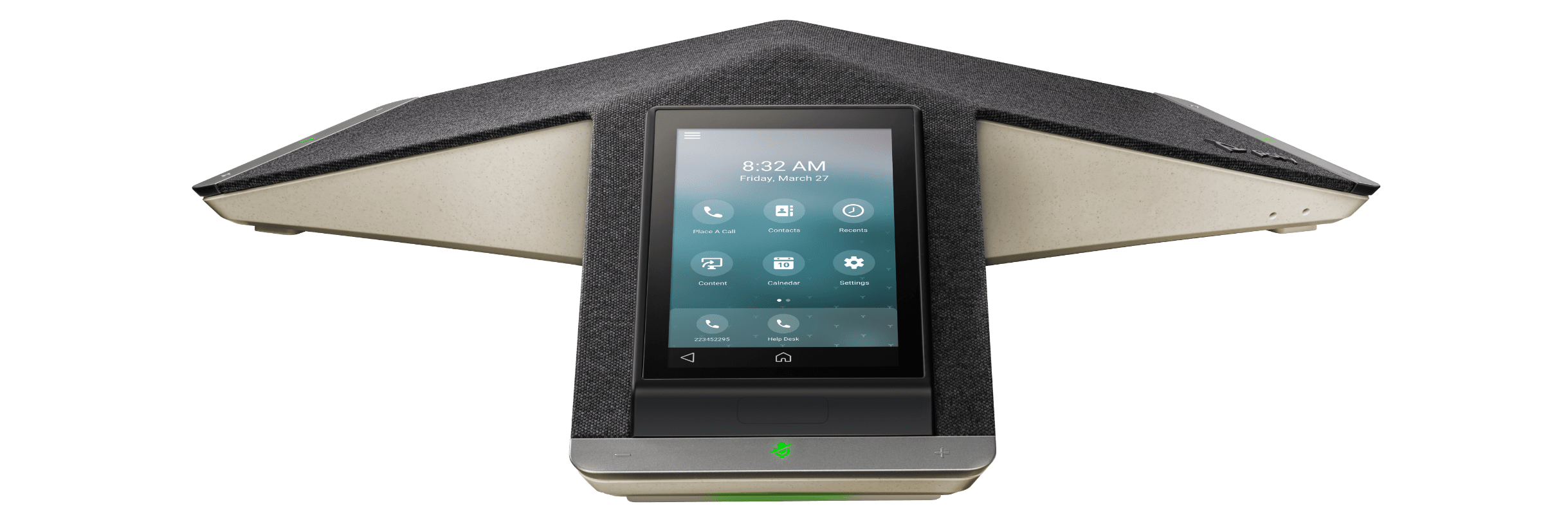
Device Gallery

How Cloud Phone Systems Work
Cloud phone systems connect users, devices, routing tools, and scalable infrastructure through a secure internet-based platform.
Connect
Make and receive calls from anywhere on any device.
Collaborate
Give teams integrated tools to work together smoothly.
Manage
Control users, call flows, features, and settings in the cloud.
Reliable
Designed for uptime, security, and business-grade call quality.
How It Works Behind The Scenes
1. User / Device
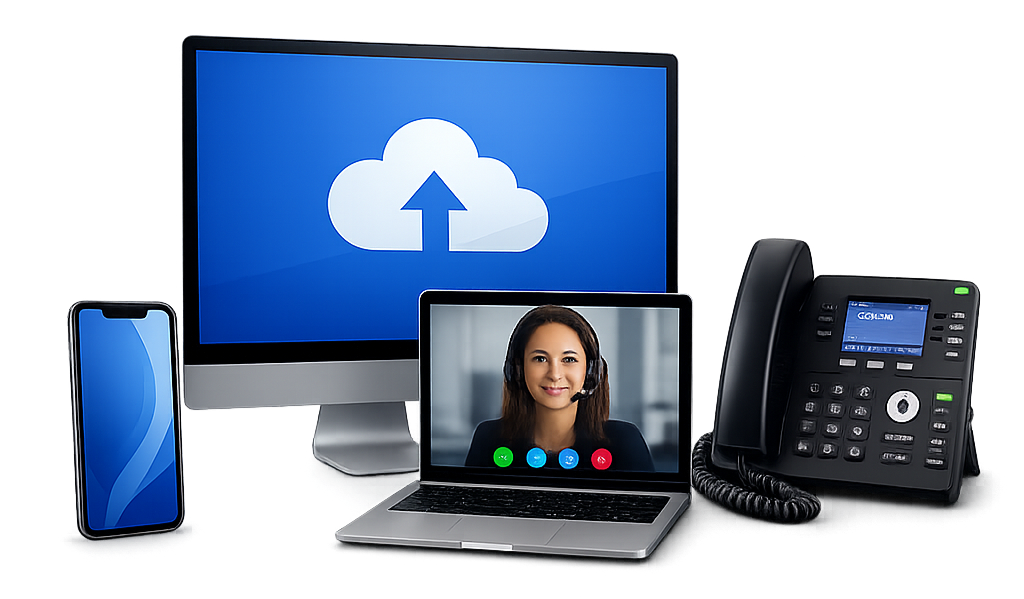
Users make and receive calls from desktop, mobile, or browser devices.
2. Cloud Platform
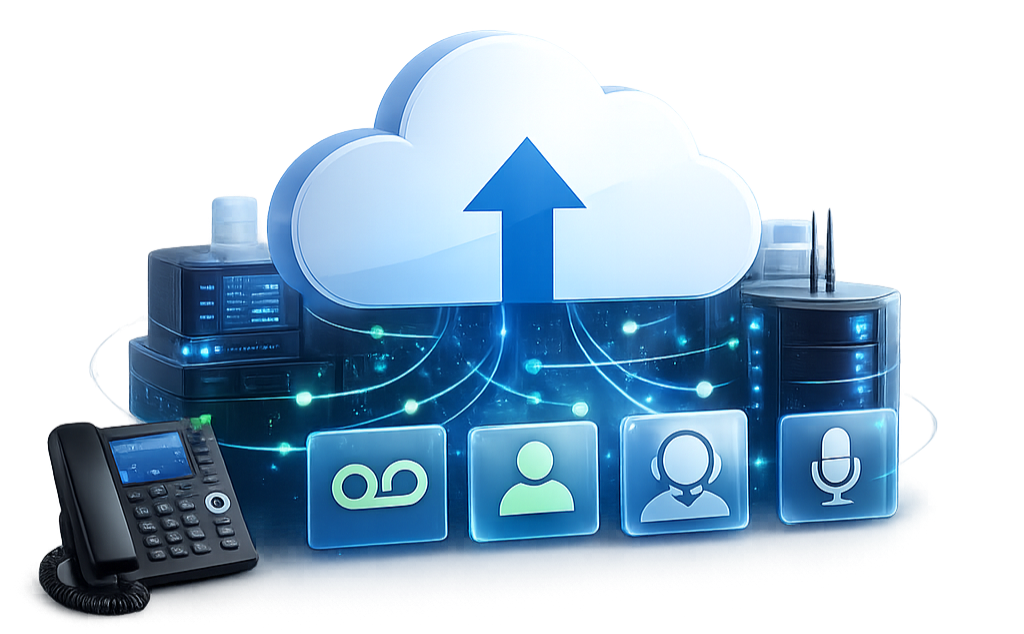
Call routing, voicemail, auto attendant, and recording run through the cloud.
3. Connect & Manage
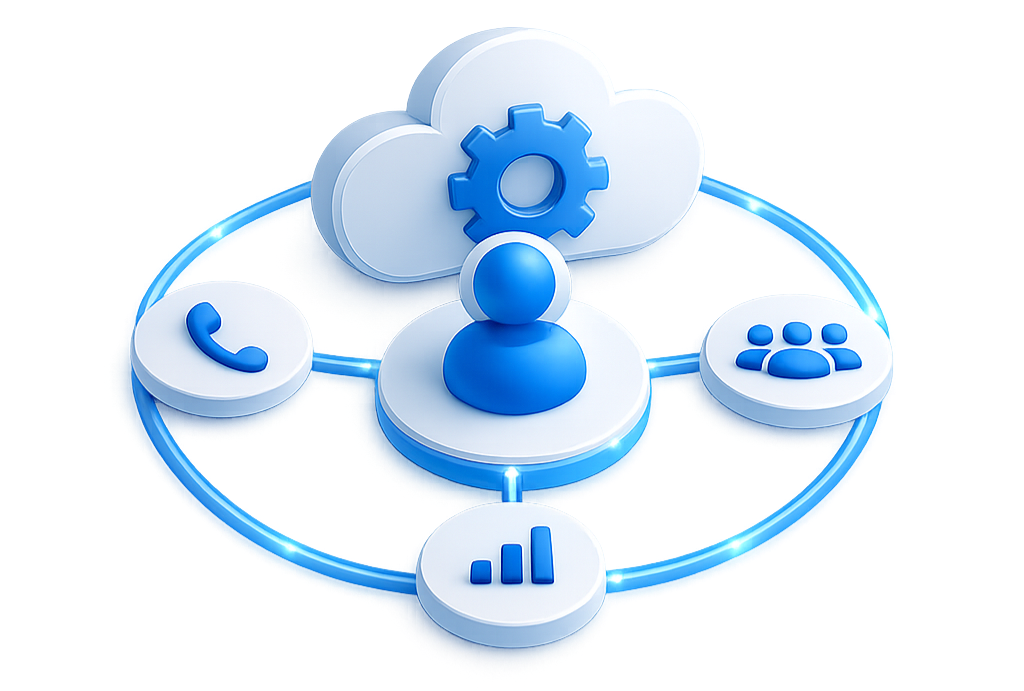
Manage users, features, and call flows in real time.
4. Reliable & Scalable
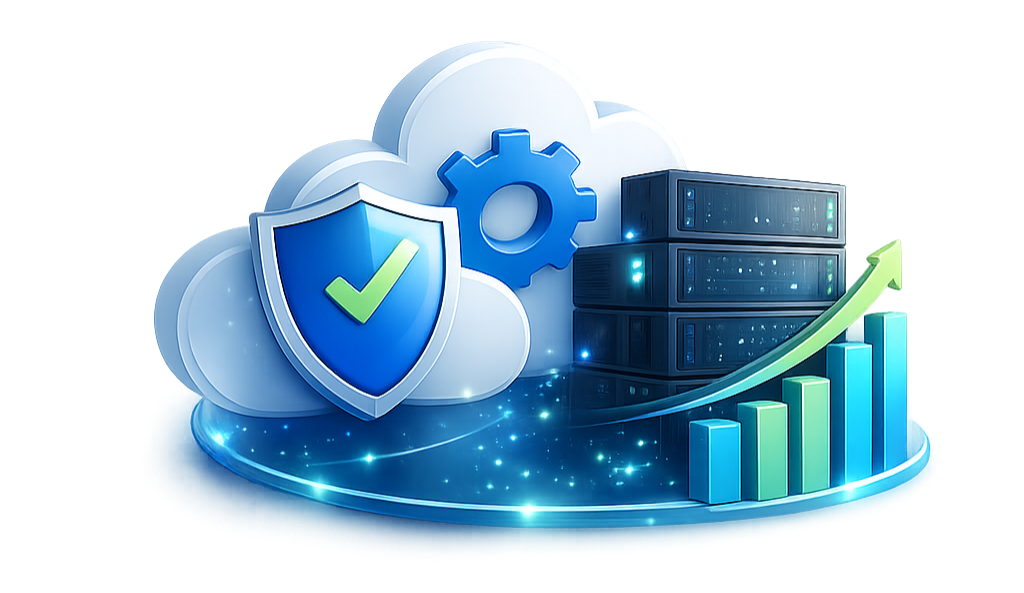
Built for reliability and scale as your business grows.
Types of Cloud Phone Systems
UCaaS
Voice, video, messaging, and collaboration in one platform.
CCaaS
Cloud contact center tools for stronger customer experiences.
Virtual Phone System
Hosted business phone systems with advanced call features.
Mobile Integrated
Use business numbers from mobile devices and remote setups.
Scalable Solutions
Add or remove users and features as the business grows.
Secure & Compliant
Built with security, encryption, and compliance protections.
Explore other AI-aligned infractructure for modern businesses
—
'%20stroke='%231c4fd8'%20stroke-opacity='0.18'/%3E%3Ctext%20x='60'%20y='110'%20font-family='Poppins'%20font-size='42'%20fill='%23061b4e'%20fill-opacity='0.72'%3ECategory%20Image%3C/text%3E%3C/svg%3E)
The phone system you choose shapes how your team communicates and how customers experience your business. While options may look similar, capabilities can vary widely. When you define your must-haves early, you can narrow choices faster and stay aligned with your workflow and budget. For many small businesses, VoIP is a smart way to deliver big-company calling features at a practical cost. Knowing what’s included helps you maximize value and choose with confidence.
Email and the web are now essential to daily operations, so speed and reliability matter more than ever. A strong connection keeps your team productive across hosting, streaming, VoIP, video meetings, and VPN use.
If you rely on bandwidth-heavy applications, dedicated internet is often the better fit than standard broadband. With DIA, you’re not sharing capacity with nearby users—so performance stays steadier during peak hours and handles traffic spikes more consistently.
Cloud and cybersecurity are foundational in modern business. As systems and data move online, protecting sensitive information becomes a non-negotiable priority.
The right cloud and security approach helps you operate safely, protect privacy, and stay aligned with compliance—so you can scale and modernize with confidence.
Dependable on-site IT support across the US, Canada, and Mexico—delivered by certified, on-demand field technicians.
We help multi-location businesses and IT providers get trusted local support. From hardware installs and network setup to structured cabling and rollouts, our technicians work quickly and professionally with proven experience you can rely on.
Business Voice
Your business phone system plays a critical role in both internal communication and customer experience. The right solution helps teams stay connected, respond quickly, and collaborate more effectively, while also creating a professional and reliable experience for customers. Although many phone systems may appear similar on the surface, the features, flexibility, scalability, and support behind them can vary significantly.
By identifying your communication priorities early, such as remote work support, call routing, voicemail features, mobile integration, conferencing, analytics, or CRM compatibility, you can more easily narrow down the best solution for your business needs and budget. A clear understanding of your operational requirements helps ensure your phone system supports your workflow today while remaining flexible enough to grow alongside your business.
Device Gallery
How Cloud Phone Systems Work
Cloud phone systems connect users, devices, routing tools, and scalable infrastructure through a secure internet-based platform.
Connect
Make and receive calls from anywhere on any device.
Collaborate
Give teams integrated tools to work together smoothly.
Manage
Control users, call flows, features, and settings in the cloud.
Reliable
Designed for uptime, security, and business-grade call quality.
How It Works Behind The Scenes
1. User / Device
Users make and receive calls from desktop, mobile, or browser devices.
2. Cloud Platform
Call routing, voicemail, auto attendant, and recording run through the cloud.
3. Connect & Manage
Manage users, features, and call flows in real time.
4. Reliable & Scalable
Built for reliability and scale as your business grows.
Types of Cloud Phone Systems
UCaaS
Voice, video, messaging, and collaboration in one platform.
CCaaS
Cloud contact center tools for stronger customer experiences.
Virtual Phone System
Hosted business phone systems with advanced call features.
Mobile Integrated
Use business numbers from mobile devices and remote setups.
Scalable Solutions
Add or remove users and features as the business grows.
Secure & Compliant
Built with security, encryption, and compliance protections.
Explore other AI-aligned infractructure for modern businesses
—
The phone system you choose shapes how your team communicates and how customers experience your business. While options may look similar, capabilities can vary widely. When you define your must-haves early, you can narrow choices faster and stay aligned with your workflow and budget. For many small businesses, VoIP is a smart way to deliver big-company calling features at a practical cost. Knowing what’s included helps you maximize value and choose with confidence.
Email and the web are now essential to daily operations, so speed and reliability matter more than ever. A strong connection keeps your team productive across hosting, streaming, VoIP, video meetings, and VPN use.
If you rely on bandwidth-heavy applications, dedicated internet is often the better fit than standard broadband. With DIA, you’re not sharing capacity with nearby users—so performance stays steadier during peak hours and handles traffic spikes more consistently.
Cloud and cybersecurity are foundational in modern business. As systems and data move online, protecting sensitive information becomes a non-negotiable priority.
The right cloud and security approach helps you operate safely, protect privacy, and stay aligned with compliance—so you can scale and modernize with confidence.
Dependable on-site IT support across the US, Canada, and Mexico—delivered by certified, on-demand field technicians.
We help multi-location businesses and IT providers get trusted local support. From hardware installs and network setup to structured cabling and rollouts, our technicians work quickly and professionally with proven experience you can rely on.
Core Services
AI‑aligned infrastructure for modern businesses
We connect your phones, network, cloud applications, and security into one coherent architecture—built to support AI workflows and hybrid teams.
Business Phone (VoIP)
Cloud-based phone systems with intelligent routing, call analytics, and AI-ready integrations built for sales and support teams.
Design and deployment of VoIP platforms
Call flow optimization and IVR
Migration from legacy phone systems
Dedicated Business Internet
High-availability connectivity engineered for always-on operations, cloud tools, and latency-sensitive AI workloads.
Circuit design and provider selection
Redundancy and failover strategy
QoS tuning for voice and video
IT, Cloud & Cybersecurity
From architecture to day‑to‑day management, we secure and optimize the systems your business runs on.
Cloud migration and optimization
Endpoint and network security
vCIO and ongoing strategy
Carriers We Work with










Carriers We Work with

Automatically route calls using AI based on intent, behavior, and context. Virtual agents can answer questions, reduce call volume, and improve response times.
Integrates calling, video meetings, messaging, and collaboration into a single platform—eliminating silos and improving productivity.
Full-featured mobile apps allow employees to stay connected anywhere with consistent call quality and experience across devices.
Track performance with dashboards showing call volume, response times, and trends—enabling data-driven decisions and optimization.
Automatically transcribe, summarize, and analyze conversations with AI—improving productivity, compliance, and coaching.
Manage voice, SMS, chat, and email in one platform—giving teams full visibility into customer interactions across channels.
Includes intelligent call queues, auto attendants, and callback options to reduce wait times and improve customer experience.
Integrates with CRM and business tools to provide context (screen pops, customer history) and automate workflows.
Enterprise-grade security with encryption, compliance support, and high-availability architecture to ensure uptime and data protection.

Modern business technology consulting.


