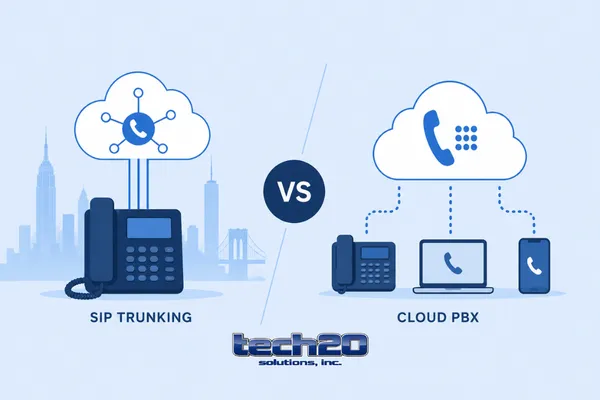
SIP Trunking vs Cloud PBX: What Is the Difference?
Choosing the right business phone system is a decision that can impact daily operations, customer service, and long-term costs. For many NYC businesses, the options often come down to SIP trunking or a cloud PBX, but the differences between the two are not always clear.
If you are planning to upgrade or modernize your phone infrastructure, understanding how these solutions compare will help you make a confident, informed choice that fits your organization’s needs.
Quick Answer
The main difference between SIP trunking and a cloud PBX is where the phone system is managed and how calls are routed. SIP trunking connects your existing onsite phone system to the internet using SIP (Session Initiation Protocol), while a cloud PBX is a fully hosted phone system managed by a provider in the cloud. The choice affects cost, control, flexibility, and the level of IT involvement your business will need.
The Essentials Every NYC Business Should Know
- SIP trunking lets you keep your existing phone system but uses the internet for calls instead of traditional phone lines.
- A cloud PBX replaces onsite phone equipment with a provider-managed system accessed over the internet.
- Cloud PBX solutions offer more flexibility and less onsite maintenance, making them popular for growing or distributed teams.
- SIP trunking can be more cost-effective for businesses with a significant investment in current phone hardware.
- The right choice depends on your current infrastructure, business goals, and how much control you want over your phone system.
How Does SIP Trunking Work for Businesses?
SIP trunking allows businesses to use their existing PBX (Private Branch Exchange) phone system while routing calls over the internet using VoIP technology. Instead of relying on traditional copper phone lines, SIP trunks connect your onsite phone equipment to a voice service provider, reducing call costs and increasing flexibility.
For many NYC businesses, SIP trunking is appealing because it extends the life of an existing phone system, allows for gradual migration to newer technologies, and can be scaled as your needs change. It is often used by organizations that want to modernize communications without completely replacing onsite hardware.
What Is a Cloud PBX and How Is It Different?
A cloud PBX, sometimes called a hosted PBX, moves the entire phone system offsite and into the provider’s cloud infrastructure. There is no need to maintain or update a physical PBX in your office. All call routing, features, and management happen in the cloud, accessible from any location with an internet connection.
Cloud PBX solutions are popular with businesses that want the latest features, built-in redundancy, and the ability to support remote or hybrid workforces. They often include user-friendly management portals and can simplify adding new locations or users. Because there is no onsite PBX, businesses have fewer hardware concerns and can reduce the need for in-house IT support.
Comparing SIP Trunking and Cloud PBX for NYC Businesses
To help you decide which option fits your business, here is a side-by-side comparison:
| Feature | SIP Trunking | Cloud PBX |
|---|---|---|
| Phone System Location | Onsite (your office) | Provider's cloud |
| Initial Investment | Uses current PBX hardware | Minimal onsite equipment |
| Maintenance | Managed by your IT team or provider | Managed by the service provider |
| Flexibility | Limited by existing PBX capabilities | Highly flexible, easily scalable |
| Best For | Businesses with onsite PBX and IT resources | Businesses seeking modern features and remote access |
Which Option Makes Sense for Your Business?
The best choice depends on your current setup, future plans, and how much control you want over your phone system. If you have already invested in a reliable onsite PBX and want to modernize without a full replacement, SIP trunking can be a practical step forward. It is especially useful for businesses that need to support legacy systems or have unique call routing requirements.
If your priority is flexibility, ease of management, and supporting hybrid or remote employees, a cloud PBX offers a modern experience with minimal onsite hardware. For NYC businesses with multiple locations or a distributed workforce, a cloud-based solution can simplify communication and reduce the IT burden.
Common Mistakes Businesses Make When Upgrading Phone Systems
One mistake we see fairly often is businesses rushing to adopt new phone technology without reviewing their current infrastructure or understanding future needs. Some companies move to cloud PBX before considering whether their internet connection can reliably support it, leading to call quality issues. Others hold on to legacy systems for too long, missing out on features that could improve productivity.
Before making a decision, review your existing phone system, evaluate your business goals, and consider the total cost of ownership over time. This approach helps avoid costly mistakes and ensures you choose a solution that can grow with your business.
What Tech20 Recommends When Comparing SIP Trunking and Cloud PBX
Tech 20 Solutions recommends starting with a business needs assessment. Identify how your teams communicate, where your employees work, and what features matter most. If your current system is reliable and meets most needs, SIP trunking can be a cost-effective way to modernize. If your business is growing, moving offices, or adopting hybrid work, a cloud PBX may deliver more long-term value.
For businesses evaluating the move to a modern Business Voice solution, understanding the differences between SIP trunking and cloud PBX is a key first step. Both options can provide reliable communications, but the right fit depends on your unique requirements.
Reliable internet is also a critical factor for both SIP trunking and cloud PBX. If you are planning an upgrade, review your Business Internet options to ensure you have the bandwidth and stability needed for clear, dependable calls.
Decision Checklist: Choosing Between SIP Trunking and Cloud PBX
- Review your current phone system and hardware investment.
- Assess your IT resources and comfort with managing onsite equipment.
- Consider your business’s need for flexibility, remote work, and future growth.
- Evaluate your internet reliability and available bandwidth.
- Compare the total cost of ownership, including setup, support, and scalability.
Frequently Asked Questions
Can SIP trunking work with any existing phone system?
SIP trunking typically works with modern PBX systems that support SIP or VoIP technology. Older or analog PBXs may need additional hardware or upgrades to connect to SIP trunks. Before moving forward, confirm compatibility with your phone system vendor or an IT consultant to avoid unexpected costs or technical issues.
Is a cloud PBX more secure than SIP trunking?
Security depends on both the provider’s safeguards and your own network environment. Cloud PBX providers often include built-in security features and regular updates. However, both SIP trunking and cloud PBX require a secure, well-managed business network to prevent unauthorized access or call fraud. It is important to work with a trusted provider and maintain strong internal security practices.
What happens if my internet goes down?
Both SIP trunking and cloud PBX rely on internet connectivity for calls. If your internet connection fails, phone service may be disrupted. Some solutions offer automatic call forwarding to mobile devices or backup lines during outages. Planning for redundancy, such as a secondary internet connection, can minimize downtime and maintain communication during unexpected interruptions.
How do costs compare between SIP trunking and cloud PBX?
SIP trunking can be more cost-effective if you already have an onsite PBX and want to reduce traditional phone line charges. Cloud PBX typically shifts costs to a monthly subscription, with less upfront investment and lower ongoing maintenance. The right choice depends on your current setup, number of users, and required features. It is best to compare total costs over several years, not just initial pricing.
Can my business switch from SIP trunking to cloud PBX later?
Yes, many businesses start with SIP trunking and move to a cloud PBX as their needs change. This phased approach allows you to maximize existing investments while planning for future upgrades. It is important to choose providers and equipment that support both options, making future transitions easier and less disruptive.
What features do businesses gain with a cloud PBX?
Cloud PBX systems often include advanced features such as voicemail-to-email, mobile apps, call analytics, easy scaling, and built-in disaster recovery. These features are managed through an online portal and updated automatically by the provider. For teams that need flexibility, cloud PBX can simplify communications and support hybrid or remote work arrangements.
Do I need a dedicated internet connection for SIP trunking or cloud PBX?
While not always required, a dedicated business internet connection can significantly improve call quality and reliability for both SIP trunking and cloud PBX. Shared or congested networks can lead to dropped calls or poor audio. Businesses with high call volumes or mission-critical phone needs should consider investing in dedicated internet services.
Build a Business Phone System That Works for You
Upgrading your business phone system is an opportunity to improve communication and support future growth. Take the time to compare options, ask questions, and involve your team in the process. The right choice will support your business today and adapt as your needs evolve.
Plan Your Business Voice Upgrade with Confidence
Every business is unique, and the best phone solution depends on your goals, infrastructure, and growth plans. Tech 20 Solutions can help you navigate the options, explain the pros and cons, and design a business voice system that fits your needs. If you want practical advice or are ready to take the next step, Learn more about Tech 20 Solutions and start a conversation with a trusted advisor who puts your business first.