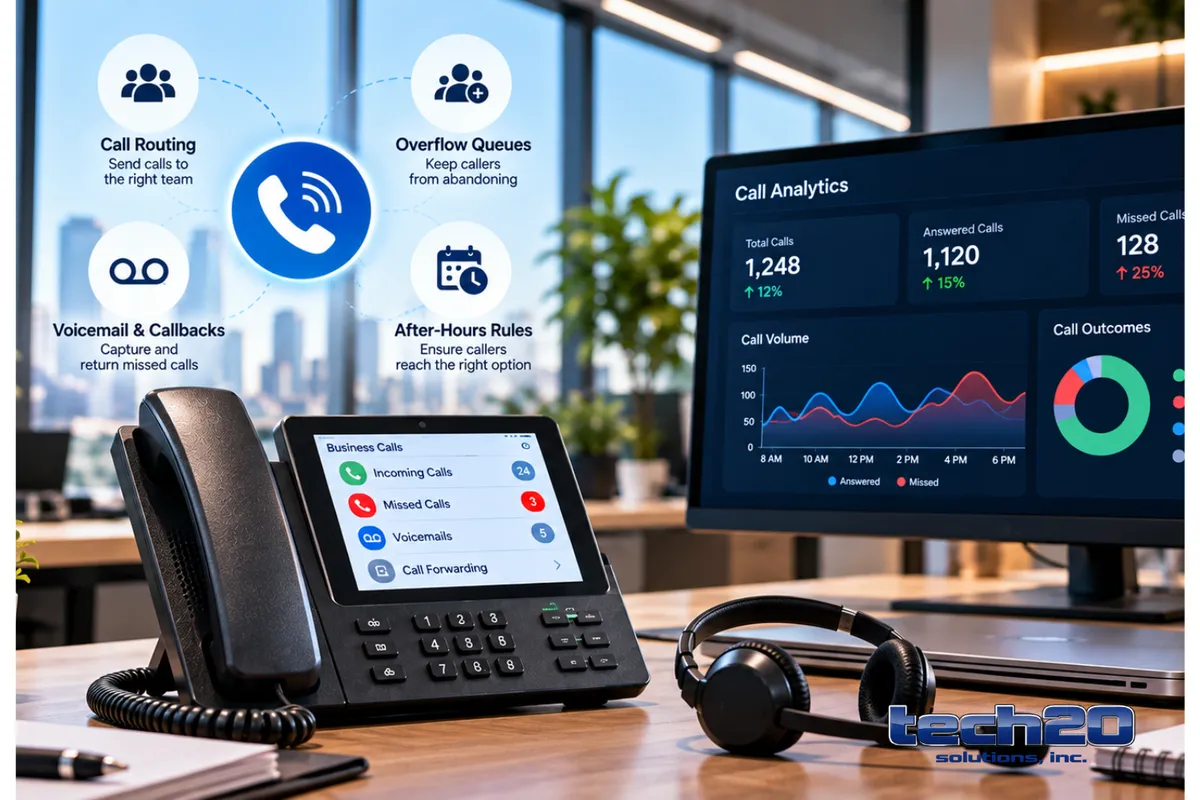
Reduce Missed Business Calls: Routing, Overflow, and After-Hours Rules
Missed business calls usually come from a mismatch between how your phone system routes calls and how your teams are staffed or scheduled. To reduce missed business calls, start by diagnosing when and where calls drop off, then apply targeted changes: adjust routing and ring strategies, add overflow queues, use voicemail and callback workflows, and set clear after-hours rules so callers reach the right team instead of getting stuck. This article shows practical steps operations and customer service leaders can use to stop avoidable missed calls and keep service levels steady.
Why Calls Are Missed: The Common Root Causes You Can Fix
Calls are missed for operational, not technical, reasons most of the time. Diagnose by time, team, call path, staffing, and overflow to find the true cause. Typical root causes include:
Routing rules that do not reflect real staffing or department responsibilities.
Ring strategies that send calls to a single person rather than a group.
Queues without overflow or callback options that let callers abandon.
After-hours or holiday schedules that default to voicemail with no clear next step.
Poor visibility into call paths and queue metrics, so problems persist unnoticed.
Missed Call Root-Cause Checklist
Use this checklist to pinpoint why calls are missed and which change will matter most. Work through items in the order below during a one-week review of call logs and staffing patterns.
Symptom | Where to Check | Immediate Action | Recommended Long-Term Fix |
|---|---|---|---|
Many abandoned calls during business hours | Queue reports by time of day; average wait and abandon events | Enable overflow to a monitored queue or voicemail with callback option | Adjust staffing or add concurrent ring/skill routing to match peak times |
Calls go to voicemail instead of team | Auto-attendant and routing rules tied to the dialed number | Temporarily change routing to a ring group or on-duty list | Reconfigure auto-attendant menus and departmental extensions |
Specific department misses calls but others do not | Team-level queue and agent availability logs | Assign backup agents to the queue | Implement skills-based routing or a shared queue model |
Misses spike after hours or on holidays | After-hours schedule and holiday routing settings | Switch to an after-hours menu with clear options and callback request | Publish schedules and set automated routing to escalation or external numbers |
Intermittent missed calls tied to outages | Network status, ISP logs, and device health checks | Failover to cellular or alternate SIP trunk if available | Improve WAN redundancy and partner with a provider that supports resilient routing |
Designing Routing And Ring Strategies That Match Staffing
Routing choices determine whether an available agent actually answers a call. For most operations: use group-based routing for departments, avoid single-person routing where possible, and choose ring behavior that reflects team size and response goals. Consider these routing options and their business implications:
Ring groups - Simple to set up and effective for small teams. Good when multiple staff can perform the same tasks.
Sequential vs simultaneous ringing - Sequential can steer calls to a defined primary responder; simultaneous increases chances someone will answer but can create internal interruptions.
Skills-based or priority routing - Routes calls to agents with appropriate expertise, reducing transfers and repeat calls but requires accurate skill tagging and management.
Presence-aware routing - Uses agent availability to avoid routing to unavailable phones; requires agents to manage their status.
When evaluating or changing routing, look for a business phone system that allows quick admin changes, easy schedule management, and clear reporting. Tech20's Business Voice solutions can help with flexible routing and admin controls to align call flows with real staffing.
When To Use Overflow Queues, Voicemail, And Callbacks
Each option solves different problems. Choose based on caller expectation and resource availability.
Overflow queues - Best when teams occasionally spike; overflow routes callers to backup agents or another department rather than letting them drop. Use when you can staff a backup queue or route to a centralized service desk.
Voicemail with callback request - Suitable when staffing is limited and callers accept asynchronous response. Improve results by capturing caller-tracking info and committing to a callback process.
Automated callback in queue - Lets callers keep their place without waiting on hold. Use when wait times are predictable and customers prefer not to stay on the line.
External escalation - Forward to a monitored external number or on-call rotation when internal staff are unavailable. Ensure escalation contacts are reliable and trained to triage.
Selecting the right combination reduces abandon rates while matching service level expectations. Test options in small pilots before broader rollout to measure caller behavior and staff impact.
After-Hours Rules That Preserve Customer Experience
After-hours misrouting creates the perception that a business is closed or unresponsive. Define clear after-hours behavior that reflects your customer promise:
Provide an explicit after-hours message that sets expectations and offers options: leave a message, request a callback, or press for urgent support.
Use scheduled routing so holiday and weekend behavior is automated; avoid ad hoc manual changes that create errors.
For critical functions, route to an on-call team or external overflow partner to maintain 24/7 coverage.
After-hours routing is as much an operational policy as a technical setting. Assign an owner to keep schedules and escalation lists current.
Operational Steps To Implement Fixes And Measure Success
Fixing missed calls requires coordination between operations, IT, and frontline teams. Follow these practical steps:
Collect call logs and queue reports covering representative busy and slow periods.
Run the Missed Call Root-Cause Checklist to identify the dominant problems.
Choose targeted remedies: routing changes, overflow queues, enable callbacks, or revise after-hours routing.
Test changes during a controlled window and capture caller abandonment, average wait experience, and agent feedback.
Document new routing rules, update training, and schedule periodic reviews to keep rules aligned with staffing changes.
When planning changes, evaluate these implementation requirements and tradeoffs:
Requirements - Admin access to the phone system, up-to-date team schedules, and call analytics.
Dependencies - Reliable network connectivity and device health; consider Business Internet for improved call reliability.
Risks - Misconfigured routing can cause larger outages or misdirected calls; use staged rollouts and maintain rollback plans.
Questions to ask providers - How quickly can routing changes be made? Is there an admin portal for non-technical staff? What reporting is available for queues and abandoned calls? How are after-hours schedules and holiday overrides handled?
Evaluation criteria - Routing flexibility, reporting clarity, ease of administration, and integration with CRM or ticketing systems.
Small Tests That Yield Quick Wins
If staffing or budget constraints limit major changes, start with these low-effort tests to reduce missed calls and improve call handling:
Test overflow routing: Enable a short overflow window that redirects calls from busy queues to a central team. Run the test for one day and compare call abandonment rates before and after the change.
Enable voicemail callbacks: Turn on voicemail callback requests and require staff to log each callback with a timestamp to track response times and follow-up completion.
Adjust the ring strategy: For one queue with a high abandonment rate, test simultaneous ringing instead of sequential ringing for a limited period. Measure whether more calls are answered while monitoring agent interruptions and workload.
Explore More Business Voice Solutions
For additional configuration ideas, feature explanations, and practical implementation examples, visit Tech20's Business Voice blog, where operations leaders can explore strategies for improving business communication and call management. If you're looking to improve your organization's phone system, call routing, or overall communication infrastructure, Get Business Voice Solutions to explore available support and solutions.