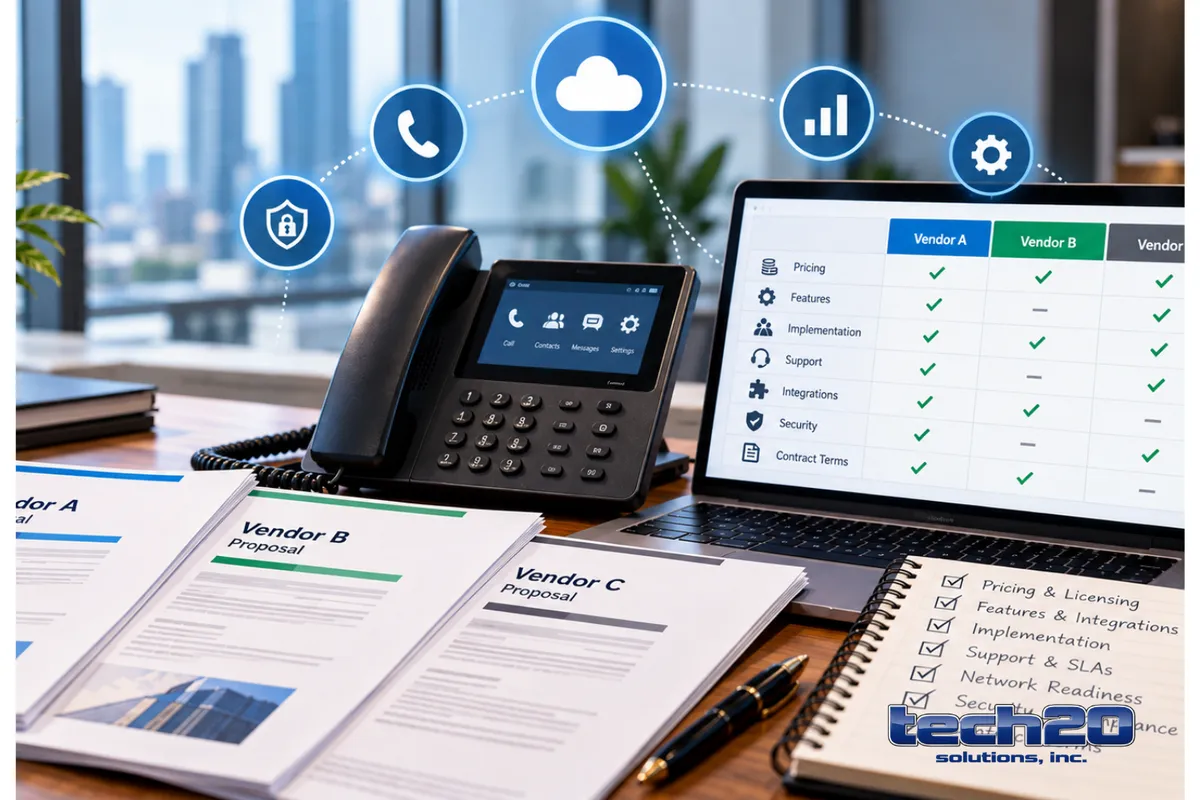
How to Compare Business Phone System Proposals: Framework and Matrix
When reviewing phone system proposals, businesses should compare more than sticker price: prioritize how each proposal maps to how your organization operates today, what will change, and which proposal minimizes operational risk while controlling long-term cost. Focus on comparable pricing models, feature parity, implementation scope, network readiness, support and escalation, contract terms, and migration risk to reach a decision that fits IT, finance, and operations needs.
Core Categories to Compare First
Start by grouping proposal details into categories that matter to decision-makers: pricing and licensing, features and integrations, implementation and migration, support and service levels, network and reliability, security and compliance, and contract terms. Comparing proposals category-by-category exposes where vendors trade lower up-front fees for higher ongoing costs or where a missing integration will create hidden work for your team.
Phone System Proposal Comparison Matrix
Use this matrix to collect and compare apples-to-apples information from each vendor. Ask each vendor to fill the same table so you can score proposals consistently.
Comparison Criteria | Why it matters | How to compare in the proposal | Red flags |
|---|---|---|---|
Pricing model | Determines cash flow and long-term cost. | Per-user vs per-seat vs bundled, hardware charges, recurring vs one-time, and clearly itemized fees. | Vague “per-seat” language, missing line items, or bundled fees without breakout. |
Licensing & feature parity | Ensure required features are included or optional add-ons. | List required features (call routing, voicemail, conferencing, mobile clients, integrations) and whether they are included, add-on, or limited. | Feature described in marketing language but not listed in licensing table. |
Implementation scope & timeline | Defines internal resource needs and disruption risk. | Detailed tasks, responsibilities, dependencies, and milestones for migration, numbering, and cutover. | High-level or missing implementation plan, or vendor assumes unlimited internal effort. |
Support & escalation | Impacts outage resolution and operational continuity. | Support hours, contact methods, SLA response expectations, and on-site options where applicable. | No escalation path, limited support hours, or unclear SLA definitions. |
Network requirements | VoIP performance depends on internet and LAN readiness. | Required bandwidth, QoS recommendations, and whether they provide network assessment or offer managed internet services. | No network assessment or unrealistic bandwidth assumptions. |
Redundancy & failover | Protects against vendor outages and site failures. | How calls failover, geo-redundancy, and number continuity are handled. | No failover plan or reliance on single data center without alternatives. |
Integrations | Productivity hinges on CRM, helpdesk, and directory integrations. | List supported integrations, required middleware, and whether they provide custom integration work. | Integration listed as future roadmap item or requires custom development with no cost estimate. |
Device policy & provisioning | Device costs and deployment effort affect rollout and support overhead. | Provisioning method, supported handset models, BYOD options, and replacement policies. | Unclear device ownership or manual provisioning for each user. |
Security & compliance | Relevant for regulated industries and risk management. | Encryption at rest/in transit, data residency, SOC/attestations if available, and call recording controls. | No mention of basic security controls or compliance capabilities relevant to your business. |
Contract terms & exit strategy | Defines flexibility and long-term vendor risk. | Contract length, renewal terms, termination fees, portability of numbers and data export processes. | Automatic renewals without notice, onerous termination fees, or no clear number-porting process. |
How to Use the Matrix: Scoring and Business Context
Score each criterion relative to your priorities rather than using a generic weight. For example, IT may weigh network requirements and provisioning higher, finance will weigh pricing model and contract terms, and operations will prioritize integrations and support. Use the matrix to surface tradeoffs: a lower monthly fee might require major internal implementation effort or purchase of hardware, which changes total cost and risk.
Questions to Ask Every Vendor
Can you provide a fully itemized cost workbook that separates one-time and recurring charges?
Which features are included in each license tier and which require paid add-ons?
What specific implementation tasks are your responsibility versus ours?
Will you perform a network assessment and provide a remediation plan if required?
How are outages handled, and what is the escalation path for critical issues?
Describe the process and timeline for porting numbers and reversing the service if needed.
Do you support the integrations we rely on, and what is the cost and timeline for custom integrations?
Common Tradeoffs and Decision Guidance
Decisions usually come down to three tradeoffs: lower upfront cost versus higher operational responsibility, bundled hardware versus BYOD flexibility, and richer included features versus modular add-ons. Match the proposal to how your organization operates today and how it expects to change. If rapid growth, remote work, or system consolidation is likely, favor proposals that offer clear scalability, simple provisioning, and predictable recurring pricing. If you have strict compliance needs or limited network capacity, prioritize vendors that include security controls and provide network remediation services.
Practical Next Steps for IT Directors, CFOs, and Operations Leaders
Define requirements: Identify must-have features, acceptable tradeoffs, and responsibilities for each team during migration.
Request vendor comparisons: Obtain a completed comparison matrix from each vendor alongside a reconciled cost workbook.
Assess network readiness: Require a network assessment and a sample implementation plan outlining responsibilities, milestones, and timelines.
Validate support commitments: Review service-level agreements (SLAs) and request references from businesses with similar operational needs and technical complexity.
Evaluate total operational impact: Look beyond monthly costs by considering internal labor, device replacement, implementation expenses, and potential downtime.
Where network readiness is a concern, evaluate internet connectivity alongside your phone system options. Tech20's Business Internet solutions can be assessed alongside voice proposals to help determine whether your existing connectivity can support reliable business communications. For voice-specific capabilities, managed deployment, and integration requirements, review the available Business Voice solutions. You can also explore the Business Voice blog for additional guidance on selecting, implementing, and managing business phone systems.
Making the Right Phone System Decision for Long-Term Business Growth
Comparing phone system proposals becomes easier when you use a structured evaluation framework and understand how your business operates today and how its needs may change. By assessing competing quotes against your IT, finance, and operations priorities, you can identify hidden costs, clarify implementation responsibilities, and choose a solution that supports long-term business growth. If you need help evaluating proposals and aligning them with your network infrastructure and deployment requirements, Get Business Voice Solutions to discuss the right approach for your organization.