Business Call Recording Policy: Storage, Access, Retention Checklist
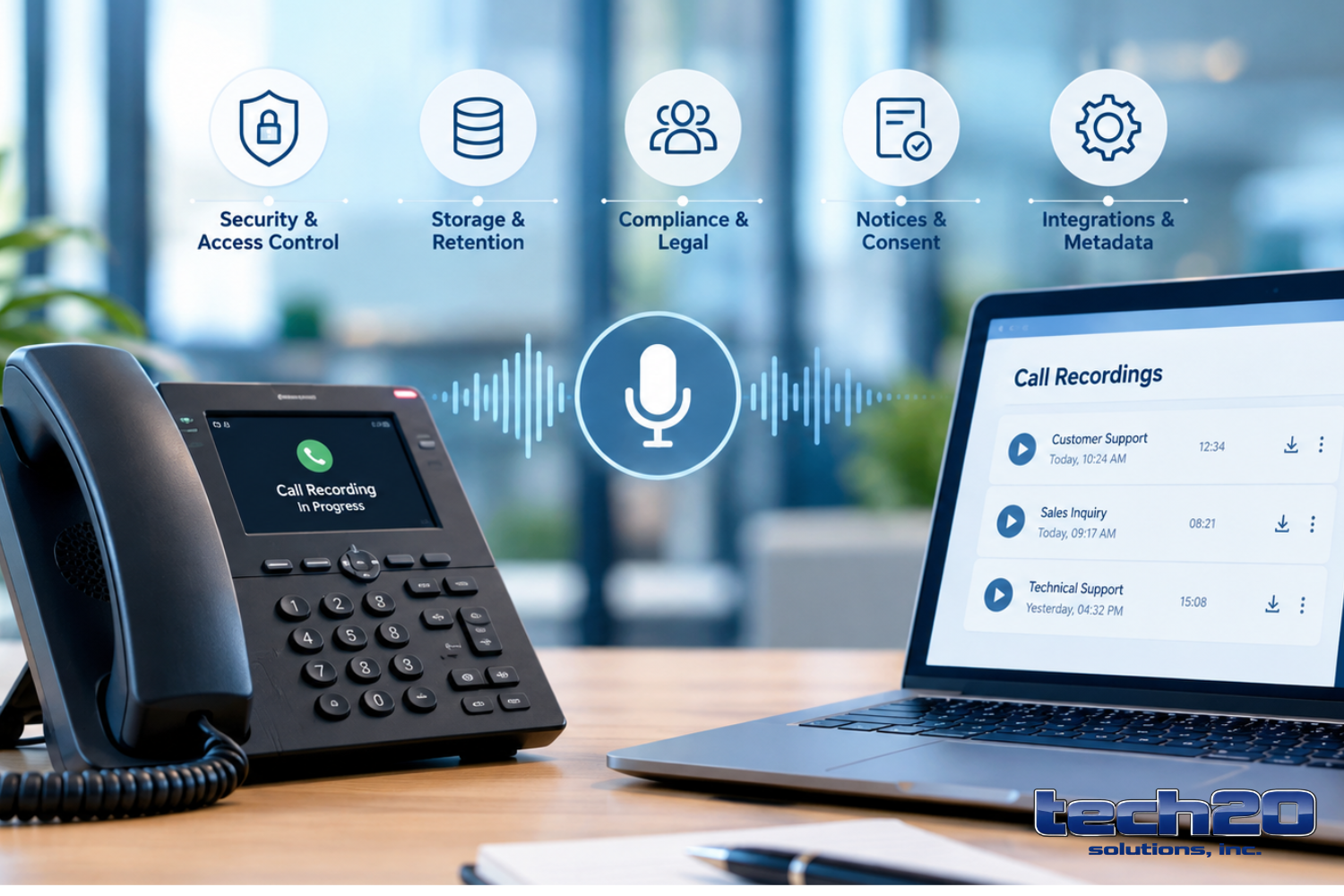
Before you enable call recording, define why you are recording, who can access recordings, where those files will live, how long they will be retained, what notices customers and staff receive, how recordings integrate with other systems, and who will review legal obligations. A clear business call recording policy turns a technical feature into an operational control that reduces risk, preserves customer trust, and makes compliance auditable.
Define Purpose, Scope, And Business Outcomes
Start by documenting the business reasons for recording. Common purposes include quality assurance, training, dispute resolution, and regulatory compliance. For each purpose, determine the minimum scope needed: which lines, which call types (inbound, outbound, internal), which agents or departments, and whether you need continuous recording or selective capture.
This scope determines downstream requirements for storage, retention, access, and tooling. For example, recordings retained for dispute resolution require reliable indexing and export features; those used for short-term coaching may need only brief retention and easy redaction.
Access Controls And Governance
Access is the most sensitive operational control. Decide who can listen to, download, copy, or export recordings and under what approvals. Use role-based rules mapped to job functions and documented approval processes. Require multi-person approval for exports of recordings that contain sensitive content or that will be shared externally.
Operational controls to specify:
Roles that can access recordings and whether access is full, masked, or limited to a transcript.
How access is granted and revoked (onboarding, role changes, termination).
Logging and audit trails for access, playback, and exports; retention for those logs.
Procedures for handling requests from employees or customers to review or delete recordings where applicable.
Storage: Location, Protection, And Operational Impact
Decide where recordings will be stored and who controls that storage. Options include vendor-managed cloud storage, your private cloud, or on-premises archival. Each option has tradeoffs for cost, control, scalability, and connectivity.
Key storage decisions to document:
Physical or cloud location(s) and data residency preferences that may affect legal exposure.
Encryption requirements for data at rest and in transit, and how encryption keys are managed.
Access logging, immutability features (if required), and export controls.
Network bandwidth and latency implications; if recordings will be voluminous, coordinate with Business Internet planning to avoid disruptions to core voice services.
Retention, Deletion, And Legal Hold
Retention policies must be purpose-driven and defensible. For each recording category, define how long to retain files, the trigger for deletion, and the method of secure deletion. Also define how legal holds are applied and how they suspend routine deletions.
Retention rules should include:
Retention period tied to purpose or regulatory requirement.
Automated enforcement where possible, with an approval path for exceptions.
Procedure for handling legal holds, including how holds are documented and how they affect exports and access.
Notices, Consent, And Customer Communication
Decide how you will notify callers and employees that calls are recorded. Notification and consent requirements vary by context and location; for some operations a recorded message or written policy is needed, while other situations may require explicit consent before recording begins. Document the required notice language, where it will appear (IVR, email, terms of service), and how consent will be captured and logged.
Include an operational checklist for IVR messages, agent scripts, and internal employee notices so the policy is applied consistently.
Integrations, Metadata, And Operational Workflows
Recordings are more useful when they include searchable metadata and integrate with CRM, ticketing, workforce management, and quality platforms. Decide what metadata to capture at the point of recording (agent ID, account number, call reason, disposition) and how that metadata will be attached, indexed, and secured.
Consider whether you need:
Automatic tagging or speech-to-text transcripts for search and redaction.
APIs for exporting recordings to other systems or for ingestion by analytics tools.
Audit and retention integration with eDiscovery and incident response processes.
Legal Review And Jurisdictional Considerations
Legal obligations differ by jurisdiction and context. Ensure legal counsel reviews the policy and each recording use case, with clear guidance on consent, data residency, cross-border transfers, and handling of sensitive content. Document who is responsible for periodic legal reviews and when policy updates are required.
Note: legal requirements vary by location and context and require appropriate review before deploying recording broadly.
Questions To Ask Providers And Internal Teams
When evaluating a telephony vendor, platform, or internal implementation, ask for concrete capabilities and operational support. Useful questions include:
How does the platform enforce role-based access and produce access logs?
Where are recordings stored, and can we choose a storage location?
What encryption is used in transit and at rest, and who manages the keys?
Can retention periods, automated deletions, and legal holds be configured by policy?
What export and redaction tools are available, and how are exports audited?
Does the provider support metadata tagging, transcription, and search APIs for integrations with CRM or analytics platforms?
What SLAs or operational support does the provider offer for recording availability and retrieval?
For telephony and call-recording features, evaluate your provider options and implementation models carefully; consider the capabilities of your phone platform such as Business Voice alongside network requirements covered by Business Internet.
Call Recording Evaluation Checklist
Checklist Item | Decision Prompts / What To Document |
|---|---|
Purpose & Scope | Why record? Which lines, call types, and teams? Continuous or selective? |
Access Roles | Who can listen, export, or delete? Approval steps for exports? |
Storage Location | Vendor cloud, private cloud, or on-prem? Data residency needs? |
Encryption & Key Management | Encryption in transit and at rest; who controls keys? |
Retention & Deletion | Retention periods by purpose; automated deletion and exception handling |
Legal Holds | How holds are applied, tracked, and how they suspend deletion |
Notices & Consent | IVR scripts, written notices, consent capture, and record of consent |
Metadata & Integrations | Which fields to capture, integration APIs, and transcript availability |
Audit & Logging | Access logs, playback logs, export logs, and retention of those logs |
Incident & Breach Handling | Who responds, how to notify affected parties, and forensic support |
Training & Governance | Staff training, policy distribution, and regular policy reviews |
Vendor Controls & Support | Exportability, portability, support responsiveness, and documentation |
Legal Review Status | Documented legal sign-off and review cadence |
Implementing The Policy And Next Decisions
Turn the checklist into actionable tasks by assigning clear owners and deadlines, including configuring call recording settings with the phone system administrator, aligning retention rules with the storage platform team, confirming network capacity with the connectivity team, and scheduling legal and HR reviews. When comparing providers, evaluate how well their default configurations align with your organization's policies and how much customization is possible without custom development. For additional guidance on operational readiness and provider evaluation, explore Tech20's Business Voice resources, which can help inform your provider selection and implementation planning. Before implementation, test the complete workflow end to end, covering call recording, metadata capture, access requests, exports with audit trails, and automated deletion.