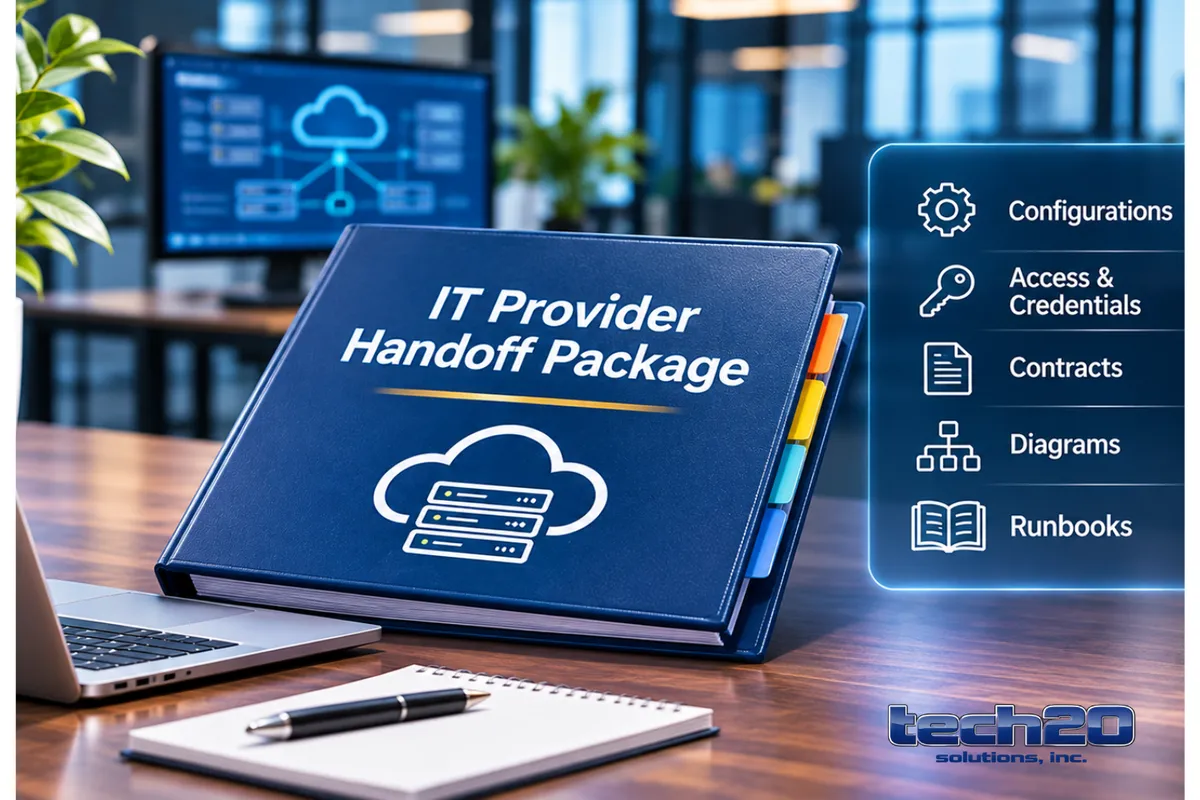
Technology Provider Handoff Checklist: What to Document Before Switching
Before you change technology providers, assemble a single, verifiable handoff package that proves ownership, shows current configurations, and documents open risks. A well-prepared handoff prevents downtime, preserves institutional knowledge, and protects ongoing operations by making the new provider accountable for the exact systems, access, and responsibilities they inherit.
What To Include In The Technology Provider Handoff Checklist
The items below are the records you must collect and verify. Each entry explains what to capture, who should own it during the transition, and the minimum verification you should require from the outgoing provider.
Asset And Circuit Inventory
What to capture: hardware serial numbers, device models, purchase/lease records, physical locations, MAC addresses, and all network circuits (carrier, circuit ID, termination points).
Ownership: IT asset owner (internal) with outgoing provider confirmation of inventory completeness.
Verify: physical spot-checks for key devices and cross-reference carrier circuit IDs with invoices or carrier documentation.
Configuration Exports And Versioning
What to capture: current configurations for firewalls, switches, routers, load balancers, wireless controllers, and on-prem appliances. Include exported files, command logs, firmware/software versions, and configuration timestamps.
Ownership: configuration custodian (outgoing provider) with a named internal approver.
Verify: perform targeted configuration reviews with your incoming provider or internal network team before cutover.
Admin Access And Credential Ownership
What to capture: admin user lists, privilege levels, MFA methods in use, vaulted credential locations, and any shared accounts with purpose and ownership noted.
Ownership: internal IT or security lead maintains master list; outgoing provider documents accounts they control and how to revoke or transfer access.
Verify: ensure credentials to be transferred are provided via a secure secrets process and that the outgoing provider demonstrates account handover procedures.
Contracts, Warranties, And Third-Party Agreements
What to capture: active contracts with expiry dates, renewal terms, termination clauses, service-level obligations, warranty identifiers, and vendor contact lists.
Ownership: legal or procurement with copies provided by the outgoing provider for any agreements they manage on your behalf.
Verify: confirm contractual obligations that continue during the transition and track any notice periods required to avoid unintended service gaps.
Open Incidents, Change History, And Known Issues
What to capture: current tickets, pending changes, recent major incidents, root cause analyses, and any work-in-progress items affecting stability.
Ownership: operations manager with outgoing provider providing full ticket exports and status notes.
Verify: agree on how in-flight work will be completed or transferred and document any temporary mitigations that must remain in place.
Escalation Paths And Contact Trees
What to capture: provider escalation roles, on-call schedules, executive escalation contacts, and expected response directions during the transition.
Ownership: vendor manager or operations director; confirm which escalations remain with the outgoing provider and which transfer immediately.
Verify: test escalation contacts with a non-disruptive confirmation message to ensure responsiveness.
Integrations And API Access
What to capture: systems that integrate with the provider (SSO, monitoring, billing, service portals), API keys, webhook endpoints, and data exchange formats.
Ownership: application owner and incoming provider for validation of integration handoff steps.
Verify: run integration smoke tests in a controlled window prior to switching live services.
Network And Systems Diagrams
What to capture: up-to-date logical and physical diagrams showing traffic flows, VLANs, trust boundaries, and connectivity between on-prem and cloud components.
Ownership: architecture lead with outgoing provider supplying editable source files (not just images).
Verify: review diagrams with the incoming team to confirm alignment with actual configurations.
Transition Responsibilities And Runbooks
What to capture: step-by-step runbooks for planned cutovers, rollback procedures, roles and responsibilities during each activity, and acceptance criteria for each milestone.
Ownership: transition manager with signoffs from both providers and internal stakeholders.
Verify: conduct at least one tabletop rehearsal of a critical cutover step to validate the runbook.
How To Organize The Handoff Package
Store materials in a single secure location with controlled access and an index. Use folders for each category above and include a brief summary document that lists items, owners, and verification status. Make sure exports are in editable formats where possible so the incoming provider can import configurations and update diagrams without rekeying.
Practical Verification Steps And Common Risks
Credential Escrow And Zero-Trust Transfer
Do not accept credentials delivered over email. Use a secrets manager or documented handover in person (or via approved secure channel) and require the outgoing provider to rotate shared credentials after transfer.
Configuration Drift And Undocumented Changes
Risk: outgoing providers sometimes maintain last-minute, undocumented fixes. Mitigation: request recent change logs and compare running configs to exported files; prioritize validation of anything marked as a workaround.
Third-Party Dependencies
Risk: services tied to third-party accounts (cloud marketplaces, carrier-managed services) may require account-level transfer or substitution. Ensure you understand which accounts you must control and which the new provider will manage.
Open Tickets And Warranty Claims
Risk: unresolved hardware or carrier issues can block a clean transition. Require the outgoing provider to list open cases, status, and the expected resolution plan, and decide who will follow up if resolution extends beyond the handoff date.
Questions To Ask Both Providers During Handoff Planning
What items in the handoff package can be delivered immediately and what requires additional procurement or approval?
Who will be the single point of contact for execution day, and how will communications be handled outside normal business hours?
Which credentials or accounts cannot be transferred and what is the documented replacement plan?
How will ownership of shared infrastructure components be updated in monitoring, asset systems, and CMDBs?
Sign-Off Checklist (Use This During Transfer)
Item | Included | Owner | Verification Notes | Sign-Off (Initials / Date) |
|---|---|---|---|---|
Asset & Circuit Inventory | Yes / No | Internal asset owner | Carrier IDs verified against invoice | |
Configuration Exports | Yes / No | Configuration custodian | Files uploaded to secure repository | |
Admin Access List | Yes / No | Security lead | Vaulted transfer confirmed | |
Contracts & Agreements | Yes / No | Procurement / Legal | Termination/renewal clauses highlighted | |
Open Incidents | Yes / No | Operations manager | Status and owner for each ticket | |
Runbooks & Diagrams | Yes / No | Architecture lead | Editable sources included | |
Transition Responsibilities | Yes / No | Transition manager | Roles and acceptance criteria defined |
How Your New Provider Should Use the Handoff
The incoming provider should treat the handoff package as the foundation for its onboarding and transition plan. Start by importing existing configurations where possible, verifying system access and integrations, and reviewing the documented runbooks. Schedule the cutover within a controlled window and make sure any identified gaps are documented, assigned, and addressed before the outgoing provider is released from its handoff responsibilities.
For organizations that need additional support preparing or validating a handoff package, a managed IT support partner can audit documentation, review configurations, and help coordinate secure credential transfers. If the transition involves on-premises systems connected to cloud services, confirm that the incoming provider understands hybrid environments and can map dependencies across the entire infrastructure. Tech20 Solutions offers Nationwide IT Support for broader managed support needs, along with Cloud Solutions for cloud-related transition requirements.
Complete Your IT Provider Transition With Confidence
Before the cutover, use the signed checklist to confirm responsibilities, document outstanding issues, and establish when contractual obligations transfer between providers. Clear documentation, coordinated execution, and mutual verification help reduce unexpected costs, prevent access issues, and minimize operational interruptions during the transition.
If your organization needs help planning, coordinating, or validating an IT provider handoff, Tech20 Solutions can help you establish a more organized transition process. Take the next step toward dependable IT support with Get Nationwide IT Support.