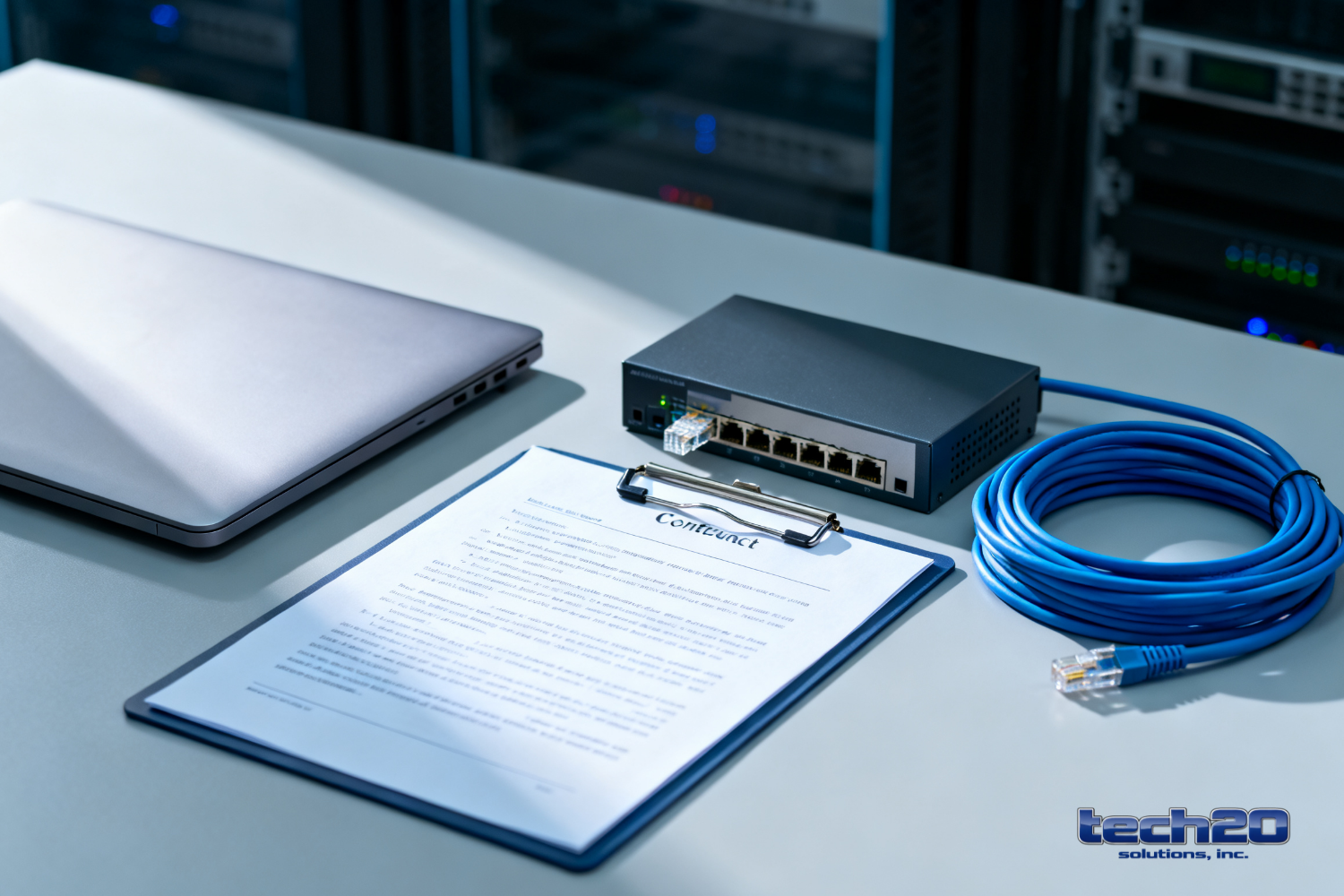
What to Review Before Signing a Long-Term Technology Contract
Before signing a long-term technology contract, CFOs, CTOs, IT directors, and operations leaders should first define what must work reliably for the business and then use that definition to evaluate the contract. Long agreements can lock you into pricing, support expectations, and technical choices that become costly if business needs or the vendor road map change. Reviewing the contract with clear, outcome-focused criteria reduces risk and gives you practical negotiating leverage.
Start by defining the business outcomes that must not fail
Begin with a short list of critical services and the business impact if they degrade. As Michael Venti advises, the right approach starts with defining what must work reliably for the business. Map each contractual service to a business process (for example, point of sale, supplier connectivity, remote work access, or customer-facing applications). For each service, document the acceptable degradation, required integrations, and compliance or reporting obligations. That definition will guide which contract terms matter most during negotiation.
Key contract terms to review and the decisions they drive
Scope of services and deliverables
Verify that the contract lists exactly what the provider will deliver, how it will be measured, and what is considered out of scope. Look for clear descriptions of hardware, software, managed services, and implementation milestones. Ambiguous scope is the most common source of disputes and change orders.
Service levels and remedies
Identify which service level objectives apply to each critical service and how performance is measured and reported. Confirm what remedies are available if levels are not met (service credits, termination rights, or specific remediation obligations). Ensure the measurement methodology and reporting cadence are stated in the contract rather than left to policy documents.
Pricing, invoicing, and change control
Confirm initial pricing components and how future price changes will be handled. Look for clauses that allow unilateral increases and require transparency on pass-through costs. Check whether hardware refreshes, software license changes, or third-party costs are included or billed separately. Require written notice and a clearly defined change-control process for any scope or price changes.
Renewal, notice periods, and auto-renewal language
Examine renewal terms closely. Auto-renewal without reasonable notice can trap you in another long term. Ensure the contract specifies the renewal term, minimal notice period to decline renewal, and any changes applied at renewal. Consider shorter renewal windows or review points aligned to your budget cycles.
Termination rights and exit/transition assistance
Termination for cause and for convenience should be spelled out, including what constitutes cause and any cure periods. Critically, require transition assistance: delivery of data, documentation, and cooperation during migration to a new provider. Define responsibilities, format and export rights for data, and a timeline for orderly disengagement.
Data ownership, portability, and backups
Confirm who owns data, who can access it, and how you can extract it in usable formats. Specify backup frequency, retention policies, and recovery responsibilities. If the provider hosts data, require explicit rights to retrieve and delete data on termination or at your direction.
Support, escalation, and governance
Define support coverage, escalation paths, and governance routines such as regular service reviews and technical road-map meetings. Make roles and responsibilities explicit so internal and vendor teams understand who owns what during incidents and routine changes.
Security, compliance, and incident handling
Require the provider to meet specific security obligations and to notify you of incidents within contractually defined windows. Include requirements for audits, vulnerability management, and compliance standards relevant to your industry. Ask for the right to request evidence of controls or third-party attestations where appropriate.
Liability, indemnity, and insurance
Assess liability caps, exclusions, and indemnity obligations. Ensure critical risks such as data breaches and service interruptions are appropriately addressed and not undermined by an unreasonably low liability cap. Verify that the provider carries insurance that aligns with the risks assigned in the contract.
Change management and product road map
Long contracts should include a mechanism for handling technology evolution. Ask how upgrades, deprecations, and roadmap changes will be handled and who pays for migrations driven by vendor decisions. Insist on advance notice and a joint planning process for material changes affecting your services.
How to evaluate tradeoffs: cost predictability versus flexibility
Long-term agreements often reduce price volatility and secure capacity, but they increase exposure to vendor lock-in and changing business needs. Evaluate whether the predictable pricing and vendor commitment justify reduced flexibility. Consider staged commitments: lock in core services while reserving flexibility for rapidly evolving components. Where connectivity or cloud-hosted services are involved, verify network and cloud portability to avoid costly rip-and-replace scenarios. For connectivity needs, confirm how the provider will support high-availability and growth on the underlying network, and review options such as Business Internet and redundancy strategies. For hosted platforms, ensure the contract aligns with your Cloud Solutions strategy and migration plans.
Long-term Technology Contract Checklist
Item to verify | What to look for | Questions to ask the provider |
|---|---|---|
Defined service scope | Explicit deliverables, exclusions, and acceptance criteria | What exactly is included, and how will out-of-scope work be approved and priced? |
SLAs and reporting | Measurable metrics, reporting cadence, and remedies | How is service measured and what are the remedies for missed targets? |
Pricing change control | Limits on unilateral increases and clear pass-through rules | How will prices change over time and what notice is required? |
Renewal and notice | Auto-renewal terms, notice windows, and renewal pricing rules | What notice is required to decline renewal and are renewal terms negotiable? |
Termination and exit assistance | Data export, documentation, and transition cooperation | What transition support is provided and at what cost? |
Data rights | Ownership, portability, retention, and deletion procedures | How will we retrieve our data and in what format? |
Security and compliance | Defined controls, incident notification, and audit rights | Can you demonstrate controls and commit to notification timelines? |
Liability and indemnity | Reasonable caps, exclusions, and insurance requirements | What risks are you willing to accept liability for, and what insurance do you carry? |
Change and deprecation policy | Advance notice and support for migrations caused by provider changes | If a feature is deprecated, what assistance do you provide to migrate? |
Negotiation levers and common red flags
Levers: shorter initial terms, pilot periods, milestone-based commitments, caps on annual price adjustments, and defined exit assistance.
Red flags: vague SLAs, unilateral price-change clauses, no data-export guarantee, minimal security commitments, and long automatic renewal windows without reasonable notice.
Next Steps for CFOs, CTOs, and IT Leaders
Use the checklist to conduct a focused contract review with your legal, procurement, and technical teams. Require providers to answer each checklist item in writing and document agreed changes through contract amendments or exhibits. Where possible, negotiate trial or pilot periods to evaluate service performance before making long-term commitments, and align renewal dates with your budgeting cycles. For critical connectivity or cloud services, validate the provider’s operational readiness, redundancy measures, and migration options early in the negotiation process.
Evaluating Business Internet Solutions and Vendor Commitments
If your organization is evaluating business connectivity options, Tech20 Solutions can help you get business internet that aligns with your operational requirements and long-term technology strategy. Before signing an agreement, carefully review vendor commitments related to network performance, uptime, service-level agreements (SLAs), technical support, and migration assistance. Establishing clear expectations upfront helps reduce operational surprises, improve accountability, and preserve flexibility as your business needs evolve.
By combining contractual due diligence with technical validation, CFOs, CTOs, and IT leaders can make more informed purchasing decisions, manage vendor risk, and build a more resilient technology environment.