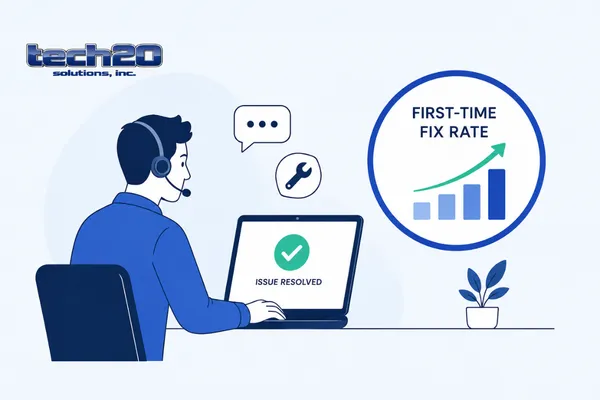
First-Time Fix Rate: Why It Matters for IT Support
The first-time fix rate is a crucial metric for IT support teams in ensuring efficient and effective service. It refers to the percentage of service requests that are resolved by technicians on the first attempt. A high first-time fix rate indicates technician efficiency and enhances service quality. For businesses, this means less downtime, fewer repeat service calls, and an overall improvement in productivity. Addressing this metric helps companies maintain operational efficiency and customer satisfaction. Now, let's delve into why understanding and improving the first-time fix rate matters so much for businesses.
Quick Answer
The first-time fix rate emphasizes resolving issues on the first try, boosting technician efficiency and service quality. Crucially, it reduces downtime and improves customer satisfaction, making it a key performance indicator for IT support teams.
Key Takeaways
- Improving first-time fix rate enhances customer satisfaction and reduces repeat calls.
- High first-time fix rates indicate strong technician efficiency.
- Critical for minimizing downtime and improving service quality.
- Impacts operational costs by decreasing repeated service visits.
- Aligns with Tech 20 Solutions’ focus on efficient business internet services.
Quick Business Snapshot
| Criteria | Details |
|---|---|
| Best For | IT support teams |
| Business Size | Small to mid-sized companies |
| Primary Benefit | Reduced downtime |
| Implementation Complexity | Moderate |
| Common Use Case | Technical issue resolution |
| Tech20 Service Fit | Business Internet |
Who Should Consider This Solution
- Fast-growing companies: With rapid growth, tackling IT issues efficiently aligns with scaling operations.
- Customer-centric businesses: High service levels ensure customer loyalty.
- Small businesses: Effective resource utilization improves profitability.
- Companies with remote teams: Minimizing remote work disruptions is crucial for productivity.
- Startups: Startups benefit from streamlined processes that first-time fixes encourage.
Why This Matters for Businesses
Achieving a high first-time fix rate is vital for businesses because it directly affects efficiency and customer satisfaction. When issues are resolved on the first attempt, it reduces operational downtime, saving companies valuable time and resources. For example, if an NYC-based startup regularly experiences network issues, a high first-time fix rate can ensure their operations remain smooth, which is essential for maintaining a competitive edge in the fast-paced business environment.
What Most Companies Miss
Many businesses underestimate the value of training and equipping their IT teams to achieve high first-time fix rates. Often, the initial focus is on speed rather than accuracy, which can lead to repetitive issues. Companies may also overlook the significance of detailed troubleshooting documentation that aids technicians in addressing complex problems effectively on the first contact, thus enhancing overall service quality.
Which Solution Makes Sense
Implementing automated diagnostic tools and investing in comprehensive technician training are key strategies for improving the first-time fix rate. These solutions make a lot of sense for companies aiming to optimize technician efficiency and reduce repeat service calls. Automated systems can streamline issue identification, freeing technicians to focus on resolving uncommon or complex problems quickly.
Where Problems Usually Begin
Problems with the first-time fix rate often start with poor initial data collection and lack of detailed problem documentation. For instance, if technicians receive incomplete information from customers or the issue isn't adequately logged, they miss the insights needed for a quick resolution. Refining the data intake process and maintaining comprehensive logs can significantly improve early-stage problem-solving.
An Example of Technology Helping Business
Hypothetical Scenario: Imagine a mid-sized NYC marketing firm struggling with frequent network downtimes, causing project delays. By using automated diagnostics to identify issues and establishing a robust technician training program, they improve their first-time fix rate significantly. Projects meet deadlines more consistently, enhancing client relations and overall productivity.
Practical Checklist
- Analyze past service requests to identify common issues.
- Invest in automated diagnostic tools.
- Enhance technician training with a focus on problem-solving skills.
- Improve the initial data collection from service calls.
- Maintain detailed documentation of past issues and solutions.
- Regularly review and refine troubleshooting processes.
What Tech 20 Solutions Recommends
Tech 20 Solutions recommends integrating automated diagnostic systems with your business internet services for improved first-time fix rates. By utilizing our expertise in business technology consulting, companies can optimize their technician efficiency and enhance service quality. This approach not only minimizes downtimes but also strengthens customer satisfaction, making it a valuable investment for any growing company.
Common Mistakes to Avoid
- Neglecting technician training—ensure all team members are well-trained.
- Overlooking the importance of accurate initial data collection.
- Failing to update and utilize troubleshooting documentation efficiently.
- Ignoring the role of automated diagnostics in resolving issues swiftly.
- Not setting realistic first-time fix rate goals based on historical data.
Frequently Asked Questions
What is the first-time fix rate?
The first-time fix rate is a metric that measures the percentage of service requests resolved on the first attempt by technicians. It is critical for assessing efficiency and service quality within IT support teams.
How can businesses improve their first-time fix rate?
Businesses can improve their first-time fix rate by investing in technician training, utilizing automated diagnostics, and ensuring comprehensive service documentation. These strategies help streamline problem-solving processes.
Why is a high first-time fix rate important for technicians?
A high first-time fix rate suggests technician efficiency and improves service quality, leading to increased customer satisfaction and reduced service costs due to fewer repeat issues.
Can a low first-time fix rate impact customer satisfaction?
Yes, a low first-time fix rate often results in repeated service calls, prolonged downtime, and dissatisfied customers, negatively impacting the company's reputation and customer loyalty.
What role does data collection play in first-time fix rate?
Accurate data collection is crucial for understanding the issue's context, allowing technicians to diagnose and resolve problems effectively on the first attempt. Poor data leads to inefficiencies and lower first-time fix rates.
Final Thoughts on Improving First-Time Fix Rates
Businesses should prioritize thoughtful planning and strategy implementation to enhance their first-time fix rates. This foresighted approach can offer a significant competitive advantage by improving service efficiency and customer satisfaction.
Why Trust Tech 20 Solutions
Business technology expertise: Our understanding of technology solutions is unparalleled.
AI automation knowledge: Innovating smarter tech solutions for your business needs.
Website and digital solutions experience: Crafting tailored solutions to fit your business goals.
Practical business-first guidance: Our focus is on optimizing your business processes for success.
Optimize Your IT Support Efficiency
At Tech 20 Solutions, we specialize in enhancing your IT support functions to achieve higher first-time fix rates. Our team helps businesses cut downtime and maximize productivity through the strategic implementation of business internet services, ensuring your operations are not just effective, but exceptional.