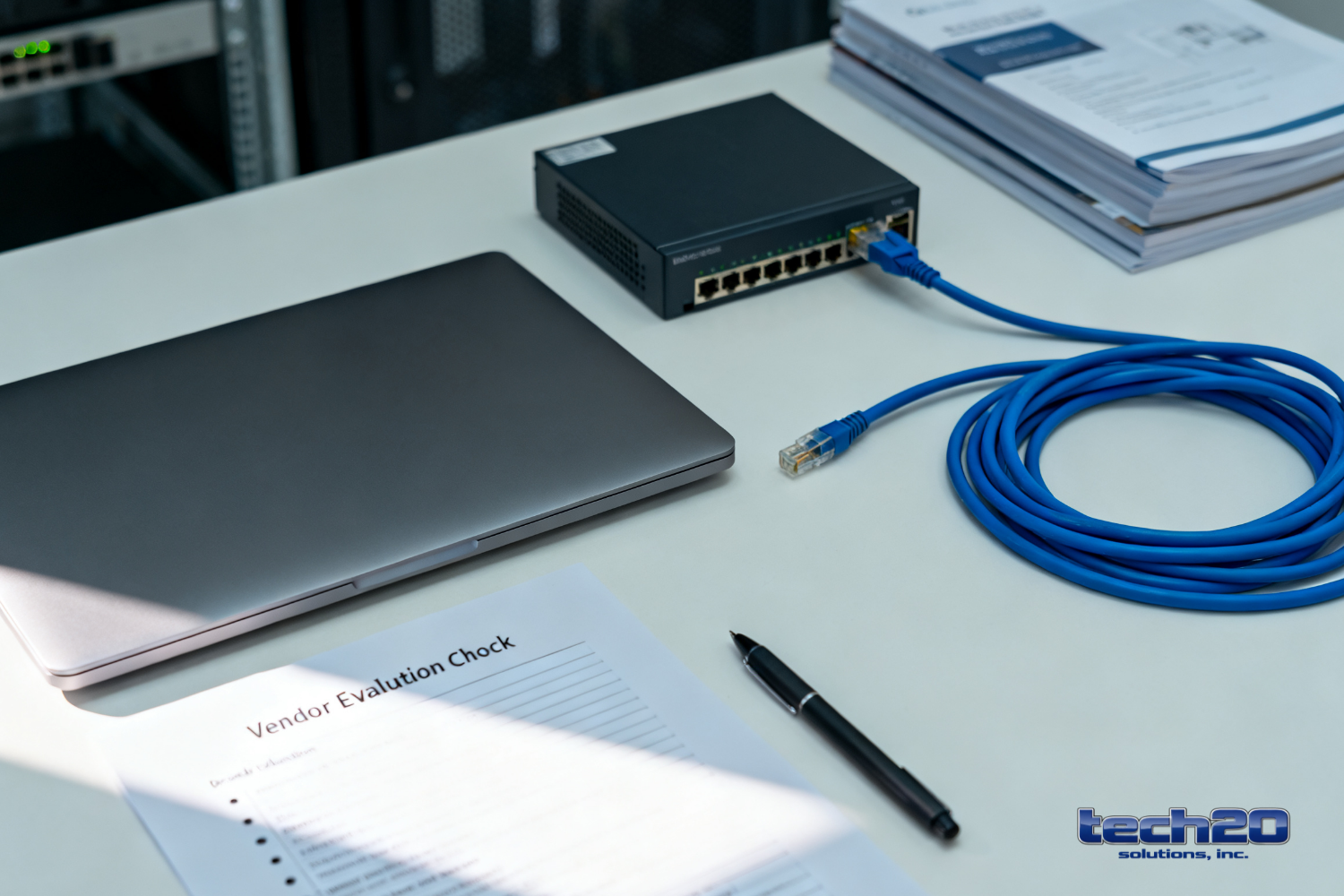
Evaluate Technology Vendors: Due Diligence Checklist for IT Leaders
To evaluate technology vendors before signing, verify not only product specifications and pricing but also how the vendor will affect day-to-day operations. Support responsiveness, implementation capability, service scope, and long-term fit all influence whether a technology investment delivers lasting value.
Use a structured vendor due diligence checklist that aligns technical capabilities with operational requirements. This approach helps CTOs, CIOs, IT directors, and CFOs make informed, sustainable decisions rather than focusing solely on short-term purchasing needs.
Vendor Due Diligence Checklist: 10 Core Areas to Verify
1. Operational Fit and Business Impact
Why it matters: A technically capable solution that disrupts workflows or increases operational burdens can reduce productivity and raise costs.
Verify how the solution will change daily processes for end users and IT teams.
Request a workflow map or implementation plan outlining handoffs, responsibilities, and expected user steps.
Ask for examples of similar customers and how adoption affected their operations.
Decision guidance: Prefer vendors that provide clear operational documentation, role-based training plans, and a staged rollout designed to minimize disruption.
2. Support Model and Escalation Process
Why it matters: Ongoing support determines system availability and the amount of time your team spends resolving technical issues.
Confirm available support channels, including phone, ticketing, and chat, as well as business-hour coverage and after-hours procedures.
Request an escalation matrix showing how issues move from first-level support to engineering and product teams.
Clarify responsibilities between the vendor and your internal IT staff, particularly for outsourced or hybrid support arrangements.
Decision guidance: Choose vendors whose support model aligns with your operating hours and incident management processes. For ongoing managed services, consider a partner experienced in Nationwide IT Support to coordinate vendor interactions and reduce operational risk.
3. Implementation Capability and Delivery Plan
Why it matters: Implementation risks can lead to cost overruns, delayed deployments, and slower realization of business value.
Require a detailed implementation plan with milestones, resource assumptions, and acceptance criteria for each phase.
Verify the availability of qualified engineers, onboarding trainers, and a designated project governance lead.
Confirm the vendor's approach to testing, user training, deployment, and post-launch support.
Decision guidance: Prefer vendors that offer pilot programs or phased deployments, with clear contingency and rollback plans for critical stages.
4. Security, Compliance, and Data Handling
Why it matters: Data access, storage, and security controls affect legal exposure, business continuity, and operational trust.
Confirm data ownership, retention policies, exportability, and administrative access permissions.
Request security documentation, including architecture diagrams, control descriptions, and vulnerability disclosure procedures.
Determine how the vendor handles security incidents, data breaches, and applicable compliance requirements.
Decision guidance: Require written commitments covering data handling and establish a plan for audits or third-party assessments when your business has compliance obligations.
5. Integration, Interoperability, and APIs
Why it matters: Poor integration increases manual work, creates data silos, and makes systems more difficult to maintain.
Map required integrations and verify API capabilities, supported protocols, and compatibility with core business systems.
Ask about middleware, authentication methods, and the management of schema changes and API versioning.
Request examples of successful integrations with systems similar to yours.
Decision guidance: Select vendors that minimize custom development and provide stable, well-documented APIs or standard connectors. For cloud projects, evaluate compatibility with your Cloud Solutions strategy.
6. Service Scope, Limitations, and Excluded Responsibilities
Why it matters: Unclear service boundaries can create disputes, unexpected expenses, and gaps in accountability.
Define what the vendor will and will not handle, including maintenance, backups, monitoring, upgrades, and security patching.
Identify which services are included in the agreement and which require additional fees.
Clarify ownership of troubleshooting, incident resolution, and ongoing system administration.
Decision guidance: Require a written scope of work as part of the contract and ensure procurement, technical teams, and the vendor agree on responsibilities before signing.
7. Cost Structure and Total Cost of Ownership (TCO)
Why it matters: The initial purchase price may not reflect the full cost of implementation, integration, training, maintenance, and eventual exit.
Request a detailed breakdown of license fees, implementation costs, recurring support, optional modules, and professional services.
Include internal expenses such as staff time, integration work, training, and change management.
Ask how pricing changes as usage increases or business requirements evolve.
Decision guidance: Compare vendors using total cost of ownership over a reasonable period, rather than comparing upfront prices alone. Consider financial flexibility as your business scales or changes.
8. Contract Terms, Renewals, and Exit Strategy
Why it matters: Contract terms determine your flexibility and financial exposure if the relationship changes or the solution no longer meets your needs.
Review renewal terms, notice periods, termination rights, and data return or deletion procedures.
Confirm who pays for data migration and transition support when leaving the vendor.
Evaluate liability limits, indemnities, and restrictions that could prevent you from switching providers.
Decision guidance: Negotiate clear exit provisions and documented data extraction procedures to reduce migration risks and avoid unnecessary vendor lock-in.
9. Vendor Stability, References, and Product Roadmap
Why it matters: A vendor's financial stability, delivery history, and product direction affect support continuity and long-term technology fit.
Request references from customers with comparable industry requirements and business scale.
Ask about recent upgrades, support experiences, and the vendor's track record of delivering promised features.
Review the product roadmap to determine whether it aligns with your strategic goals.
Decision guidance: Give greater weight to vendors that demonstrate consistent delivery, transparent communication, and a realistic product roadmap.
10. Testing, Pilots, and Proof of Value
Why it matters: Pilots help reveal technical limitations and operational challenges before a full deployment.
Require a pilot or proof of concept with measurable acceptance criteria based on real business processes.
Test integration behavior, support responsiveness, usability, and performance under expected workloads.
Document pilot results and identify unresolved issues before making a final commitment.
Decision guidance: Use pilot outcomes as formal inputs for contract negotiations and go/no-go decisions. Agree on success criteria before testing begins.
Practical Questions to Ask Every Technology Vendor
Use these questions during vendor interviews, demonstrations, and due diligence meetings:
How will our day-to-day operations change after this solution goes live?
Who will support our account, and how will escalations be handled?
Which implementation deliverables are included, and what services will cost extra?
How will you protect, export, and return our data if we terminate the agreement?
Can we run a pilot with measurable acceptance criteria and clearly defined responsibilities?
What ongoing maintenance, monitoring, and security responsibilities will remain with our team?
How will pricing, support, and performance change as our business grows?
How to Use This Checklist in a Formal Vendor Evaluation
Turn the checklist into a vendor scorecard that documents requirements, supporting evidence, and acceptance criteria for each area. Assign reviewers from IT, finance, operations, and procurement so each team can assess the risks relevant to its responsibilities.
Require vendors to provide supporting materials before final approval, including project plans, security documentation, customer references, pricing breakdowns, and proposed contractual terms. Score vendors consistently and document any unresolved risks, exceptions, or conditions that must be addressed before signing.
Apply Michael Venti's key point: look beyond immediate technical specifications and evaluate how the vendor will affect day-to-day operations. A solution that looks attractive on paper may still be a poor choice if it creates unnecessary complexity, unreliable support, or ongoing costs.
How Tech20 Solutions Can Help
For complex technology engagements, a reliable support partner can help coordinate vendors, manage post-deployment support, and reduce operational risk. Tech20 Solutions' Nationwide IT Support services help businesses address operational support needs, while its Cloud Solutions guidance helps evaluate integration requirements and long-term scalability. For additional vendor evaluation guidance and practical technology insights, explore the Nationwide IT Support blog.
When you're ready to strengthen how your business evaluates and manages technology vendors, Tech20 Solutions can help align vendor capabilities with your operational requirements, support expectations, and long-term technology roadmap. This approach helps internal IT teams stay focused on strategic priorities while reducing avoidable implementation and support challenges. Learn how our team can support your business through Get Nationwide IT Support and build a more reliable, sustainable technology strategy.