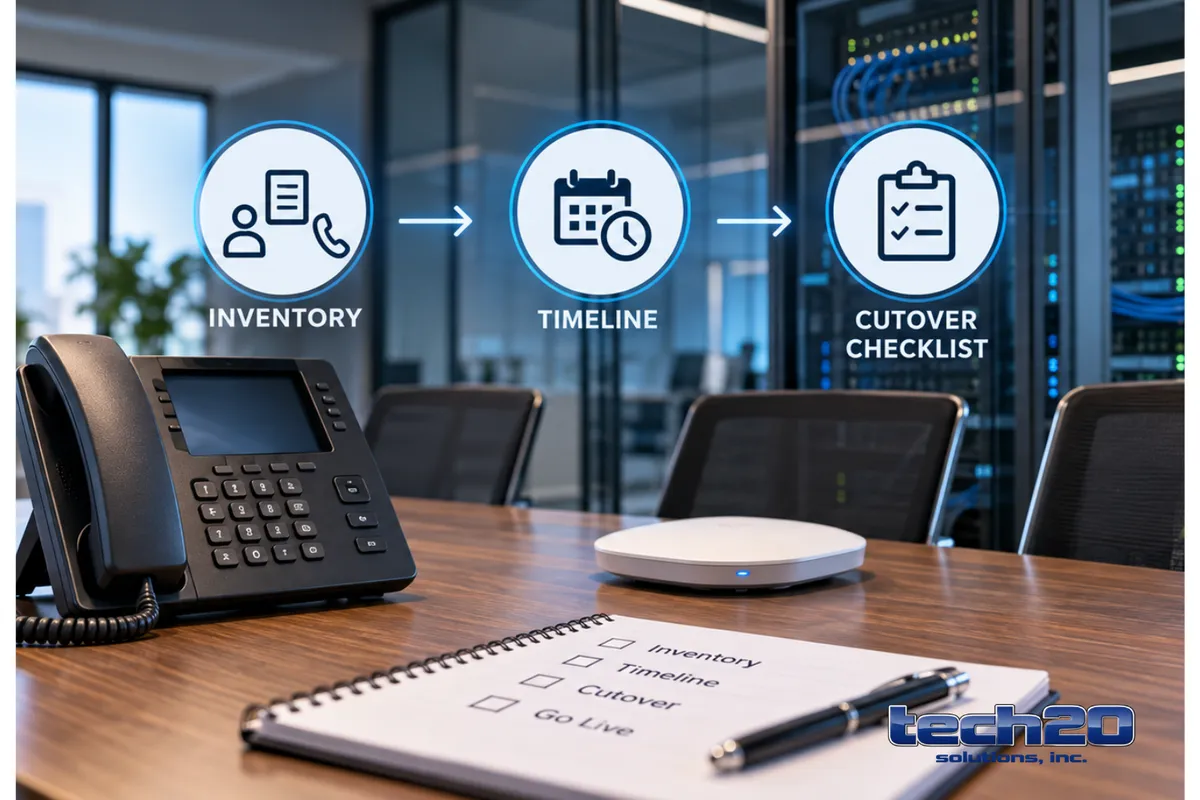
Business Phone System Implementation Plan: Inventory, Timeline, and Cutover Checklist
Before deploying a new phone system, plan around the gap between how your organization currently operates and the required operating condition for day one cutover. A complete business phone system implementation plan must bring together users and phone numbers, device provisioning, network readiness, integrations, security, and a clear cutover sequence so those dependencies do not cause unexpected downtime or support overload.
Map the Gap: What to Inventory and Why It Matters
Begin by documenting the current environment and the target operating condition so you can identify gaps that will drive the project plan. That inventory is the foundation for a reliable phone deployment and should include:
User and number inventory: active extensions, DID assignments, hunt groups, shared lines, emergency numbers, and any numbers scheduled for porting or retirement.
Device inventory: phones, headsets, conference room devices, analog endpoints (fax, door systems), and any unsupported legacy hardware.
Network and topology: WAN and LAN capacity, segmentation, existing QoS policies, NAT/firewall behavior, and Wi-Fi coverage where softphones will be used.
Integrations and workflows: directories (AD/LDAP), contact center systems, CRM, calendar sync, and any SIP trunks or PSTN gateways.
Security and compliance: authentication method, encryption requirements, and regulatory considerations for call recording or retention.
Support model and staffing: who will manage provisioning, training needs, and escalation paths for post-cutover issues.
Essential Components of a Practical Implementation Plan
Turn the inventory into requirements and actions. For each component below, define the requirement, the dependency that can block progress, and the key decision an IT or operations director must make.
Users and numbers
Requirement: an authoritative mapping of user accounts to extensions and DID numbers.
Dependency: number porting and DNS updates coordinated with carriers; any misalignment can cause inbound call loss.
Decision: whether to conserve existing number structures or to rationalize ranges during migration.
Devices and provisioning
Requirement: a device plan that covers procurement, firmware compatibility, and automated provisioning profiles.
Dependency: network access and VLANs for device provisioning servers; legacy analog devices may need gateways or replacements.
Decision: managed devices versus user-provided softphones and how provisioning will be secured.
Network readiness
Requirement: predictable voice quality across sites and remote workers through appropriate capacity and QoS controls.
Dependency: WAN links and internet uplinks, firewall rules for SIP/RTP, and VLAN separation to protect voice traffic.
Decision: invest in WAN changes, MPLS or dedicated circuits, or optimize existing broadband with traffic prioritization.
Integrations and business processes
Requirement: integration points for directory sync, presence, contact center routing, and CRM click-to-call.
Dependency: API availability, account credentials, and testing environments for validation.
Decision: scope integrations for the initial cutover versus phased rollout to reduce risk.
Security and compliance
Requirement: secure authentication, encrypted media where required, and hardened edge devices.
Dependency: firewall and session border controller configuration and security reviews before go-live.
Decision: selective feature lockdown at launch versus enabling all features immediately.
Training, documentation, and support
Requirement: role-based training materials and a rapid-response support roster for the first hours after cutover.
Dependency: availability of subject-matter experts and change communication channels to users.
Decision: conduct broad training before cutover or targeted training with on-demand resources during migration.
Phone System Implementation Timeline
The most practical timeline is organized around phases that close the gap between the current state and the required operating condition. Use this phase-based timeline as the plan backbone; map tasks and owners to each phase and track dependencies that can block progress.
Phase | Primary objective | Key activities | Critical dependencies | Deliverable |
|---|---|---|---|---|
Discovery and design | Establish authoritative inventory and target architecture | Complete user/number/device inventory, define call flows, design network and security model | Access to existing systems and carrier information | Requirements document and design diagram |
Network and security preparation | Ensure the network supports predictable voice quality and secure connections | Apply VLANs/QoS, open firewall ports, configure session border controllers, validate internet paths | Network change windows and firewall change approvals | Network readiness signoff and test logs |
Provisioning and integration | Build accounts, provision devices, and connect integrations | Automate device provisioning, connect directory/CRM, configure call routing and voicemail | API credentials, device firmware compatibility | Provisioned accounts and integration test results |
Pilot and validation | Validate features and call quality with representative users | Run pilot calls, collect QoE feedback, exercise failover and emergency dialing | Pilot user availability and monitoring tools | Pilot signoff and known-issue log |
Migration and cutover | Move users and numbers with minimal business disruption | Execute number porting, update DNS/SIP routing, switch users in planned batches, monitor call flows | Carrier porting windows and coordination with change control | Completed cutover and roll-forward/rollback plan |
Post-cutover support and optimization | Stabilize operations and tune system settings | Resolve remaining issues, gather performance metrics, refine provisioning | Support staffing and monitoring visibility | Operational handover and optimization plan |
Cutover Strategies that Reduce Risk
Stage users by department or location so issues affect a limited group and can be remediated before broader rollout.
Run the old and new systems in parallel for key inbound numbers until porting and routing are verified.
Coordinate number porting with carriers early and schedule porting windows when business impact is lowest; have temporary forwarding options prepared.
Establish clear rollback triggers and the exact steps to reverse a change if critical failures occur.
Communicate proactively to users and provide quick reference guides and a fast-response support channel for the first hours after each migration wave.
Checklist: Questions IT and Operations Leaders should answer before Committing
Do we have a single authoritative inventory for users, numbers, and devices?
Is our network configured to prioritize voice and to protect signaling/media traffic?
Which integrations are required at launch and which can be phased?
How will number porting be coordinated and what are the fallback options?
Who is accountable for each dependency and are change windows scheduled and approved?
What is the support model for the first days after cutover and how will escalations be handled?
Have security and compliance implications been reviewed and documented?
How cloud infrastructure and security fit into the plan
Decisions about hosting and edge security influence both risk and operational overhead. Cloud-hosted voice platforms can simplify provisioning and integrations while reducing the need for on-site hardware. However, successful implementation requires careful planning for cloud network connectivity, redundancy, and identity integration. These elements should align with your cybersecurity controls to maintain session security and ensure proper firewall configuration. Explore Cloud Solutions for architecture guidance and Cybersecurity resources to support your broader security strategy. For additional implementation insights and real-world examples, visit the Cloud Solutions blog.
Aligning Cloud Voice Infrastructure, Network Readiness, and Security Controls
By planning these elements together, your organization can bridge the gap between its current environment and the requirements of the new phone system. This coordinated approach helps reduce the risk of disruptions caused by overlooked users, phone numbers, devices, network dependencies, or cutover activities.
When you're ready to turn your plan into an actionable implementation roadmap, Tech20 can help align cloud-based voice, network readiness, and security controls to support a smooth, low-disruption deployment. Our team can work with your IT and operations leaders to sequence dependencies, validate design decisions, and prepare for cutover. Explore Cloud Solutions.