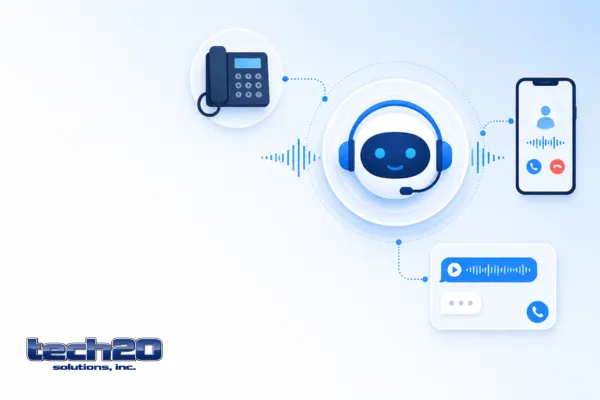
AI Voice Agents Explained: How Businesses Are Using AI for Calls
Business owners across New York City are hearing more about AI voice agents, but there is often confusion about what these solutions really do and how they fit into daily operations. With customer expectations rising and call volumes steady, many are asking if AI can help manage or even improve their phone interactions.
This article breaks down what an AI voice agent actually is, how it works behind the scenes, and why more NYC businesses are exploring AI for calls, reception, and customer service roles.
Quick Answer
An AI voice agent for business is software that uses artificial intelligence to answer, route, and manage phone calls automatically, simulating a human conversation. It works by combining voice recognition, natural language processing, and decision logic to understand callers and respond in real time. This technology can help NYC businesses handle high call volumes, improve customer experience, and streamline receptionist tasks.
How AI Voice Agents Are Changing Business Calls
- AI voice agents for business NYC use AI to answer, route, and manage phone calls with minimal human involvement.
- These systems use conversational AI to understand natural speech and provide real-time responses.
- AI phone agents can handle routine questions, schedule appointments, and route calls based on caller needs.
- Many NYC businesses use AI voice agents to reduce wait times and free up staff for more complex tasks.
- Choosing the right AI solution involves evaluating business needs, call volume, and integration with existing systems.
What Exactly Is an AI Voice Agent?
An AI voice agent is a virtual assistant that interacts with callers using artificial intelligence. Unlike traditional phone menus or simple auto-attendants, these agents use conversational AI to understand spoken language, ask follow-up questions, and take actions based on what the caller says. In other words, they can hold a natural conversation rather than just playing recorded prompts.
For example, an AI voice agent might greet a caller, ask how it can help, understand a request to "schedule an appointment," and guide the caller through the process—all without a human receptionist picking up the phone.
How Does an AI Voice Agent Work?
AI voice agents combine several technologies to deliver human-like phone interactions:
- Speech recognition converts spoken words into text the system can process.
- Natural language processing (NLP) analyzes the caller's words and intent.
- Conversational logic determines the best response or action based on the conversation.
- Text-to-speech turns the agent's response back into natural-sounding speech.
These systems are typically cloud-based, which means they can be updated, managed, and improved remotely. Many solutions also integrate with business tools like calendars, CRMs, or ticketing systems to automate tasks beyond just answering calls.
What Can AI Voice Agents Do for NYC Businesses?
NYC businesses use AI voice agents in a variety of ways, from handling high call volumes to providing after-hours support. Here are some of the most common applications:
- Answering frequently asked questions (like business hours or directions)
- Routing calls to the correct department or person
- Scheduling appointments or reservations
- Collecting information for support tickets or service requests
- Screening calls and reducing spam or robocalls
- Providing multilingual support for diverse NYC callers
Many NYC service companies find that AI phone agents allow staff to focus on more complex customer needs rather than repetitive tasks. This can improve productivity and customer satisfaction at the same time.
AI Voice Agents vs. Traditional Phone Systems
| Feature | AI Voice Agent | Traditional Auto-Attendant |
|---|---|---|
| Understands natural speech | Yes | No (touch-tone only) |
| Can answer questions | Yes | Limited |
| Schedules appointments | Often | No |
| Routes calls by intent | Yes | Only by number selection |
| Provides 24/7 service | Yes | Yes |
If your business is considering AI voice agents or cloud-based solutions to modernize your call handling, our AI Solutions page explains how these tools can be tailored to meet your specific needs.
Where Do AI Voice Agents Make the Most Business Sense?
AI voice agents are especially valuable for NYC businesses that handle a high volume of repetitive calls, such as appointment-based service companies, retail locations, or organizations with multilingual customers. They are also useful for businesses that want to provide 24/7 support without hiring overnight staff.
However, not every situation requires full automation. For complex, sensitive, or high-value customer interactions, a human touch may still be preferred. Many businesses combine AI receptionists with live staff to balance efficiency and personal service.
Businesses interested in integrating AI voice agents with cloud-based phone systems or other business tools may also benefit from exploring Cloud Solutions that support flexible, scalable communication strategies.
What Tech20 Recommends When Considering AI Voice Agents
From a technology planning perspective, the best results come from matching the AI solution to the business problem. One mistake we see fairly often is choosing a system based on features alone, without considering how it will interact with your current phone setup, staff workflow, or customer expectations.
Before implementing voice AI, assess your call patterns, identify what tasks should be automated, and make sure the solution can integrate with your existing business systems. Testing with real callers is essential. A successful rollout usually involves adjusting scripts and logic based on real-world feedback.
What Businesses Should Consider Before Choosing an AI Voice Agent
- Call volume and complexity: Do you receive enough routine calls to benefit from automation?
- Integration needs: Will the system work with your current phone service and business applications?
- Language support: Does your business need multilingual or accent-aware AI receptionists?
- Customer experience: Will callers be comfortable interacting with an automated agent?
- Staff training: Are your employees ready to manage and support the new system?
Evaluating these factors helps avoid common pitfalls and ensures your investment actually solves the business problems you are facing.
Frequently Asked Questions
How do AI voice agents differ from traditional auto-attendants?
AI voice agents use conversational AI to understand natural speech, answer questions, and guide callers through tasks. Traditional auto-attendants rely on touch-tone menus and cannot interpret open-ended requests. AI agents can handle more complex interactions and provide a more natural experience for callers.
Can AI phone agents replace human receptionists?
AI phone agents can handle many routine receptionist tasks, such as answering common questions or routing calls. However, for complex, sensitive, or high-value conversations, a human receptionist may still be necessary. Many businesses use AI receptionists to support staff rather than fully replace them.
What types of calls are best suited for AI voice agents?
Routine and repetitive calls, such as appointment scheduling, order status, business hours inquiries, or call routing, are ideal for AI voice agents. Calls that require empathy, negotiation, or in-depth troubleshooting are often better handled by human staff.
How secure are AI voice agents for business calls?
Leading AI voice solutions use secure cloud infrastructure and encryption to protect call data. However, businesses should verify security features and compliance standards before selecting a provider, especially if sensitive information is discussed over the phone.
Can AI voice agents handle multiple languages or accents?
Many advanced AI voice agents offer multilingual support and can recognize a variety of accents. For NYC businesses with diverse customer bases, this feature is valuable. It is important to test language support with your actual callers to ensure quality and comfort.
Do AI voice agents integrate with business tools like calendars or CRMs?
Yes, most modern AI voice agents can integrate with popular business applications, allowing them to schedule appointments, update records, or trigger follow-up actions automatically. Integration capabilities are a key consideration during the selection process.
How much setup or training is required to implement an AI voice agent?
Setup varies by provider and complexity. Some solutions can be configured quickly with basic call flows, while others require more customization and integration with existing systems. Ongoing training and adjustments are often needed to fine-tune performance over time.
Plan for the Right Kind of Call Automation
As you evaluate whether an AI voice agent is right for your business, consider your callers' needs and your team's workflow. Matching technology to your actual business problems is the best way to see results and avoid wasted investment.
Modernize Your Calls with Trusted AI Solutions
Exploring AI voice agents can help your business streamline call handling and improve customer experience. Tech 20 Solutions can help you assess your needs, compare options, and implement the right solution for your environment. If you want to learn more about how AI can support your business, Learn more about Tech 20 Solutions. Every business is unique, and the right conversation can help you make a more confident decision about your next steps.